
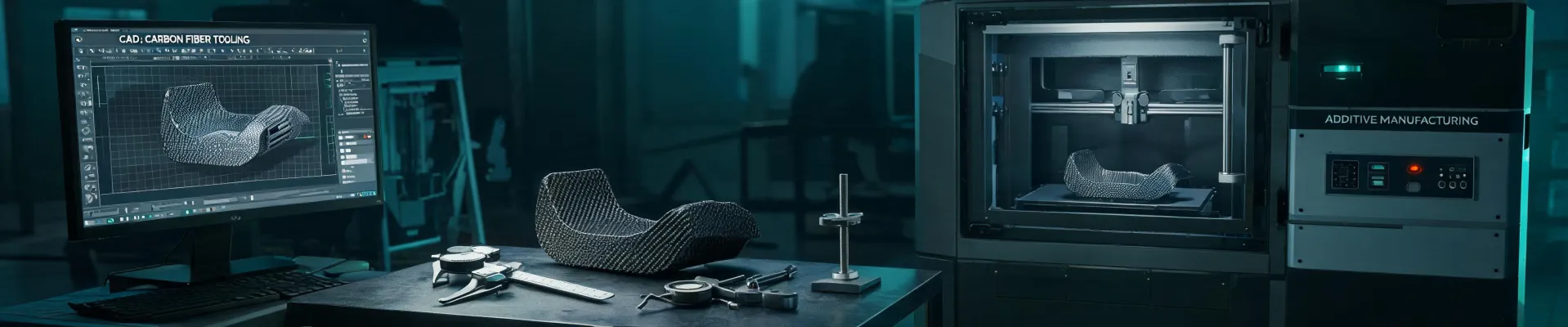
Thursday afternoon, 3:47 PM. A client calls with a production line down. They need 12 carbon-fiber-reinforced brackets by Monday morning. They've spent the last two days comparing X1 Carbon 3D printer specs and reading about 3D printers that can print carbon fiber. Normal lead time for this kind of part: ten days. We delivered in 72 hours. But not because of a printer.
That's the part nobody wants to hear. If you're searching for 'x1 carbon 3d printer specs' or asking whether 3D printing requires GPUs, you're probably looking for a hardware answer. I've done that too. It's comfortable. Specs are concrete: build volume, layer height, max nozzle temperature. The rest of manufacturing is messy.
In my role coordinating custom manufacturing for Carbon-3D, I've handled 200+ rush orders in 15 years, including same-day turnarounds for clients who had no backup plan. This pattern shows up more often than it should.
The Wrong Question: Which Machine?
When I'm triaging a rush order, the first thing I ask is not 'which printer did you pick?' It's 'what problem are you actually trying to solve?' Because most people don't need a printer. They need a part, and they need it before the deadline.
If you're looking at the X1 Carbon 3D printer specs, you'll see numbers like a 256 mm cubic build volume and a 300°C hotend. Those are good numbers, and the X1 Carbon is a capable machine. To be fair, it's one of the better desktop options for carbon-fiber-reinforced filament. But the 'carbon' in the name doesn't mean the part comes out as a structural carbon-fiber component. It means the machine can push filament that contains carbon fiber. There's a big difference.
This is also where the GPU question shows up. Does 3D printing require GPUs? No. The printer does not need a GPU—it uses its own controllers. A GPU can speed up slicing on a computer, especially with large triangular meshes (think 1 GB STL files), but in 15 years, I've never seen anyone miss a deadline because their printer lacked a GPU. They miss deadlines because the geometry, material, and process weren't thought through.
What 'Carbon Fiber' Actually Means in 3D Printing
Most 3D printers that can print carbon fiber use chopped carbon-fiber filament. The material is typically a polymer like nylon or PETG with tiny carbon fibers mixed in. It's stiffer and more dimensionally stable than the base plastic. It can make excellent brackets, fixtures, and prototypes. But it is not the same as a continuous carbon-fiber laminate, and it's not automatically stronger in every direction.
The strength of a printed part depends on layer adhesion, orientation, infill pattern, and wall count. Print the same CF-PA part flat, and it may hold one load. Print it on its side, and the layers may separate at half the load. No spec sheet tells you this. A material datasheet with tensile values from a standard like ASTM D638 is a better starting point than any printer brochure.
I'm not a materials scientist, so I can't speak to the chemistry of every carbon-fiber blend. What I can tell you from experience is that the machinery is rarely the reason a part fails. The confusion about material behavior is.
The Hidden Cost of Spec-Sheet Decisions
Let me share what this looks like in practice. In March 2024, 36 hours before a trade show, a client called. Their previous vendor had promised a carbon-fiber part made on a popular desktop printer. The part looked fine on the outside, but it had failed during dry-fit because the holes were off by 0.4 mm. The client had already spent two weeks choosing 'the right printer specs.' They didn't need a machine. They needed someone to make a part that fit, fast.
We pulled the CAD file, checked the critical dimensions, and switched from 3D printing to CNC machining for that geometry. It was the right call for a part with tight hole positions. We paid $850 in rush fees on top of the $2,400 base cost, and delivered parts by the next morning. The client's alternative was showing up at the trade show with a prototype that didn't fit.
Last quarter, we processed 47 rush orders with 95% on-time delivery. Those numbers sound good until you look at the other 5%. The late ones were rarely late because a machine broke. They were late because the real problem wasn't in the specs: a file was missing, a tolerance was unclear, or someone had chosen a material from a marketing page without checking how it behaved.
This is the part that local search won't solve either. Search 'injection molding Ames' and you'll find molders in Iowa. Search 'cutting tool Milwaukee' and you'll find suppliers in Wisconsin. Those can be valuable starting points. I recommend local suppliers when they fit the job. But a local search doesn't tell you whether the shop has run your material, whether they'll be honest about tolerances, or whether they'll answer the phone at 5:00 PM on a Friday. In an emergency, those are the specs that matter.
What I Actually Check When the Deadline Is Short
I learned this the hard way. In my first year, I made the classic specification error: I assumed a chopped carbon-fiber filament would behave like the injection-molded part we'd quoted. It didn't. That cost us a $600 redo and a lot of embarrassment. I've also skipped a final review because I was rushing—the part was 'basically the same as last time.' It wasn't. $400 mistake.
Now the checklist is non-negotiable. When a rush order comes in, I ask five things:
- Critical dimension: Which measurement actually makes the part fit or fail? (Not the one that's easiest to measure.) Focus the review there.
- Load path: Not 'is it strong?' but 'where will it be weakest?' A print orientation that avoids stress on layer lines changes everything.
- Real deadline: When does the part need to be installed, not just shipped? That changes which process can win.
- Process risk: If the geometry has tight tolerances, machining may beat printing—even if printing is faster to start.
- Backup plan: If this attempt fails, what's the second move? It should be named before the first move starts.
Five minutes of verification beats five days of correction. That sounds like a slogan, but it's math. A one-hour DFM review is cheaper than an overnight remake. A material datasheet read on day one is cheaper than a field failure on day ten. Prevention is almost always cheaper than the rush fix.
At Carbon-3D, we do 3D printing, CNC machining, laser cutting and welding, and injection molding. I'm not here to tell you that 3D printing beats CNC or that carbon-fiber 3D printing is always the answer. It isn't. Some parts should be machined. Some should be molded. Some should be printed on a machine that looks nothing like an X1 Carbon.
If you're still comparing printer specs, fine. Just remember that the most important specs don't appear on a machine datasheet: response time, engineering judgment, and the willingness to say 'this won't work before you spend the money.' That's the difference between a part that arrives on time and a part that arrives looking great but failing under load.
This was accurate as of early 2025. Printer specs and materials change fast—verify current specifications before you buy or quote.
And if a load-bearing carbon-fiber part is going into a safety-critical or flight application, this gets into composites engineering territory, which is not my expertise. Consult a composites engineer. But for the 95% of urgent production problems I see? Prevention, not cure, is the answer.