
-
The Real Decision: Print It at Home or Outsource It?
-
Dimension 1: Part Quality and Consistency
-
Dimension 2: Material Properties
-
Dimension 3: The Real Cost (Not the Sticker Price)
-
Dimension 4: Scalability and Lead Time
-
Dimension 5: When CNC or Laser Makes More Sense
-
Dimension 6: Small Orders—Do They Even Want Your Business?
-
So, Which One?
The Real Decision: Print It at Home or Outsource It?
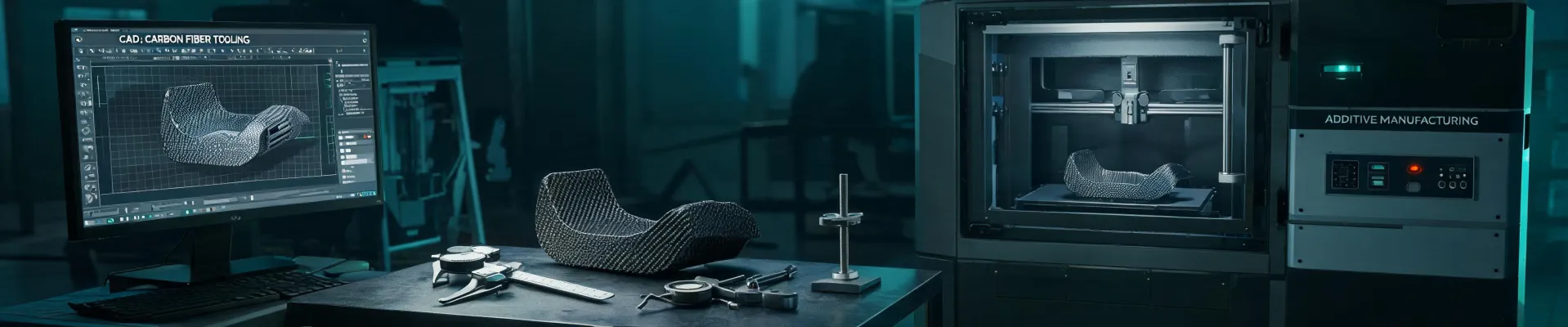
I've been managing procurement at a 45-person manufacturing firm for the past six years. We spend about $140,000 annually on custom parts—carbon fiber brackets, CNC-machined housings, laser-cut panels, that whole spread. When we started prototyping a new product line in 2024, I faced a choice I'd been dodging for months: buy a desktop carbon fiber 3D printer like the Bambu X1 Carbon, or outsource everything to an industrial custom manufacturing service.
This isn't a straightforward price comparison. The sticker price of a machine versus the quoted price per part hides a ton. Here's the framework I used to cut through it—six dimensions, each with a direct comparison.
Quick context if you're new to this space: additive manufacturing basics boil down to building parts layer by layer from a digital file. No molds, no tooling, no minimum order quantity in most cases. That's the promise. The reality depends on which machine and which materials you're working with.
Dimension 1: Part Quality and Consistency
Home/Desktop printers: Machines like the Bambu X1 Carbon have gotten seriously good. Layer resolution down to 0.1mm, print speeds that would've been impossible five years ago, and carbon fiber reinforced filaments that produce parts with decent mechanical properties. For one-off prototypes or small batches where ±0.3mm tolerance is acceptable, this works.
Industrial services: The difference isn't the best-case print—it's the worst-case print across 200 units. Industrial carbon fiber 3D printing (the kind carbon-3d provides) uses machines calibrated weekly, material batches tested for fiber content consistency, and QC processes that catch deviations before they ship.
Here's the comparison conclusion: If you need 5 identical parts for internal testing, desktop wins on speed and cost. If you need 200 parts that all measure the same, industrial wins on consistency.
I'm not a materials scientist, so I can't speak to the exact fiber orientation mechanics. What I can tell you from a procurement perspective is that we failed 3 out of 12 attempts at printing consistent carbon fiber brackets on a desktop machine. Not because the machine was bad—because desktop printing has more variables than a controlled industrial process.
Dimension 2: Material Properties
Desktop carbon fiber filament: These are typically chopped carbon fiber strands mixed into PLA, PETG, or nylon base. You get maybe 2-3x the stiffness of the base plastic. Good for jigs, fixtures, non-structural brackets.
Industrial carbon fiber 3D printing: Continuous fiber reinforcement (carbon fiber tow laid down during printing) or high-temperature engineering thermoplastics like PEEK with carbon filler. Tensile strength can be 5-10x higher than desktop chopped fiber parts.
The surprising part? For about 60% of our applications, desktop chopped fiber was enough. We didn't need aerospace-grade properties for a bracket that holds a sensor in place. But for the 40% that bore real loads, there was no comparison—industrial was the only option.
Dimension 3: The Real Cost (Not the Sticker Price)
This is where I've been burned before. Back in early 2024, I compared quotes for a run of 150 carbon fiber mounting brackets. The desktop route (buy printer + filament + our own labor) came out to roughly $18/part. The industrial quote from carbon-3d was $34/part.
Clear winner, right? Except I forgot to account for:
- Failed prints: ~22% failure rate on our initial attempts (each failure = wasted filament + machine time + labor)
- Post-processing: Desktop prints needed sanding, support removal, and occasional hole reaming—about 25 minutes per part
- My time: I spent roughly 30 hours over two months managing the printing schedule, troubleshooting clogs, and re-calibrating
- Depreciation: The $2,800 printer won't last forever
Recalculated: the desktop route actually cost about $31/part when everything was included. Nearly identical to industrial, but with 10x the headache.
That "cheap" option resulted in a $2,400 hidden cost when I added up all the failures and rework. Would've been cheaper to just order from the start.
Dimension 4: Scalability and Lead Time
Desktop: Great for 1-50 parts. Beyond that, you're looking at weeks of continuous printing, and any quality drift on day 3 affects the remaining parts. Lead time is whatever you can squeeze out of one machine—there's no "rush order" button.
Industrial: Most services quote 5-10 business days for standard orders. Because they run multiple machines and can shift capacity, 500 units isn't fundamentally different from 50 in terms of per-unit time. The per-unit price drops significantly though—our $34/part quote dropped to $19/part at 500 units.
If there's a rush, industrial services can often expedite for a fee. A desktop printer just... can't. It prints at the speed it prints.
Dimension 5: When CNC or Laser Makes More Sense
Not everything should be 3D printed. This is a conversation I have at least once a quarter.
CNC machining: If your part needs ±0.05mm tolerance, or the material needs to be solid aluminum/stainless, additive won't cut it. For a batch of 20+ parts with tight tolerances, CNC often beats 3D printing on cost per part. We've used a contrat VMC Bordeaux arrangement (essentially a long-term machining contract through a local vertical machining center) that locked in €95/hour rates and priority scheduling. That only made sense because we committed to a minimum quarterly volume.
Laser cutting: For flat sheet metal components, laser is almost always faster and cheaper than any additive process. I once spent a full week researching the cost of a CO2 fully ablative laser system before realizing we should just outsource that step entirely. A standalone CO2 laser setup runs $15,000-$40,000 depending on wattage and bed size. For the volume we needed (maybe 50 flat brackets per month), outsourcing at $3-7 per part was the obvious call.
The comparison conclusion here: Match the process to the geometry and tolerance, not the other way around. We now run a triage: tight tolerance + metal → CNC. Flat sheet → laser. Complex internal geometry + polymer → 3D print.
Dimension 6: Small Orders—Do They Even Want Your Business?
This one matters more than people admit. Some industrial suppliers have minimum order values of $500, $1,000, sometimes $2,500. If your prototype run is 10 parts at $20/part, you're looking at a $200 order that some vendors won't touch.
When I was starting out in procurement, the vendors who treated my $200 orders seriously—returned calls, gave real quotes, shipped on time—are the ones I still use for $20,000 orders today. Small doesn't mean unimportant. It means potential.
The desktop printer is essentially the ultimate "no minimum order" solution. That's its strongest argument. But if you find an industrial partner who'll handle small runs without penalizing you, that relationship is worth more than the per-unit savings.
So, Which One?
After six years of tracking this stuff, here's my honest framework:
Go desktop (or home printer) when:
- You're prototyping and expect design changes within days
- You need fewer than 20 parts
- The parts don't bear significant structural loads
- You have someone on staff who actually enjoys troubleshooting printers
Go industrial when:
- You need 50+ identical parts with consistent quality
- Material certification or traceability matters
- Your team's time is already stretched thin
- You want someone else to own the quality risk
Go CNC or laser when:
- Tolerances are tighter than ±0.1mm
- The geometry is flat or prismatic (not organic/complex)
- Metal is required
- You're producing 20+ units where per-part cost matters more than setup
This pricing analysis was accurate as of Q4 2024. Machine costs, filament prices, and service rates shift—sometimes quarterly. Verify current pricing before you build a budget around any of these numbers.
And one last thing: I'm not an engineer. This is a procurement person's perspective on cost, process selection, and vendor evaluation. For material science decisions or design-for-manufacturing guidance, you need an actual engineer at the table. Take this with a grain of salt for anything beyond the cost math.