
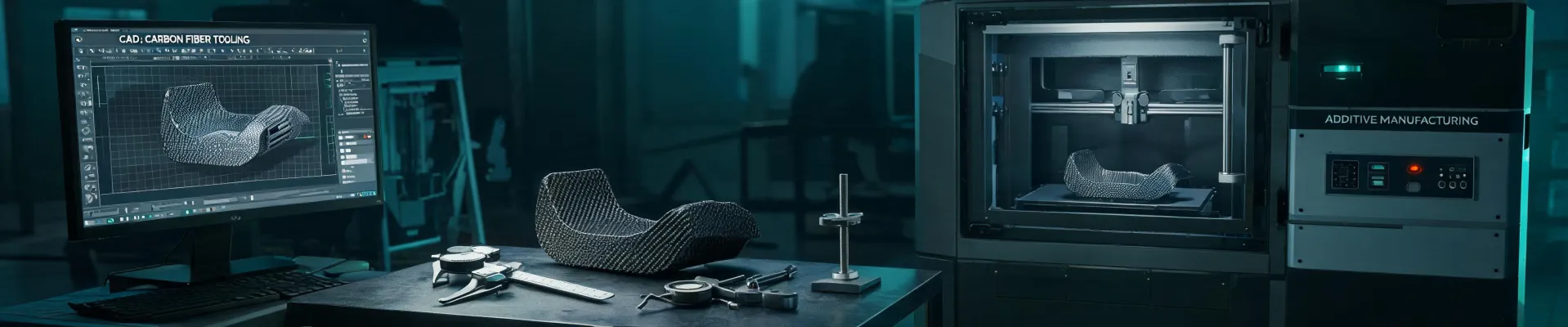
If you search for “carbon” in manufacturing, you aren't asking one question. You're asking at least two or three different questions that happen to share a word. A desktop “carbon” 3D printer may not print the same material as an industrial carbon-fiber process. A CO2 laser isn't a carbon-fiber process, and in medical searches it isn't a manufacturing process at all. The right answer depends on your scenario.
I'm the quality and brand compliance manager at carbon-3d. I review roughly 200 customer-facing parts and supplier documents every year before they’re approved to ship. In this role, I've learned to reject the word “carbon” whenever it appears without a specification—not because people are dishonest, but because carbon is used as a marketing shortcut in more product categories than almost any other word.
When I first started in custom manufacturing, I assumed that a “carbon fiber reinforced” quote meant the supplier and I were picturing the same material. I was wrong. A vendor delivered brackets that looked close to our approved sample—same dark texture, same gloss—but they failed well below the expected load. The material sheet said “carbon filled,” which was technically true. The fiber form, orientation, fiber loading, and test method did not match the drawing. That redo taught me to separate the machine model from the material specification.
Scenario 1: You're comparing desktop “carbon” 3D printers
This scenario is behind searches like “Bambu Lab X1 Carbon,” “Elegoo Centauri Carbon 3D printer specs review,” and “Creality K1C 3D printer reviews.” The printers in that group are often called carbon-capable because they can run carbon-fiber-reinforced filaments with the right nozzle, enclosure, and settings. That doesn't automatically make the output a structural carbon-fiber part.
If the query was “bamboo 3d printer x1 carbon,” the product is the Bambu Lab X1 Carbon. That typo is common. Fixing the spelling is easier than fixing an unchecked material spec.
What I ask before approving an in-house printer proposal:
- The full material path. Carbon-filled filaments are abrasive. A hardened steel nozzle, a filament dryer, an enclosed chamber, and a heated bed are decision items, not accessories.
- A test piece in the target orientation. A flat coupon can hide weak layer adhesion. If the real part stands on end or carries load across layers, print it that way.
- A definition of success. Is this part for a one-off fixture or a 500-piece run? The answer changes the acceptable price per part and the acceptable failure rate.
A printer review is a starting point. It tells you about setup, slicing profiles, and support. It doesn't tell you whether a spool of carbon-filled nylon from a different filament brand will meet your drawing. The printer is one variable. Filament moisture, print temperature, layer height, and chamber temperature can change the result more than the brand on the front panel. For fit checks, small fixtures, and low-load brackets, a desktop printer can be the fastest answer. The problem starts when the machine's marketing name is treated as a material certificate.
Scenario 2: You need a production carbon-fiber part
The second scenario is different: you don't want a printer, you want parts. You need stiffness, heat resistance, low weight, or a specific test report. Now I stop looking at machines and start looking at the material specification.
Carbon-fiber-reinforced materials are not one category. Chopped carbon fibers in a thermoplastic filament improve stiffness and reduce warpage, but part strength still depends on layer bonds. Continuous fiber 3D printing places fibers in selected paths and can make more load-bearing parts, but it's not the same as a machined plate or a molded component. CNC machining from carbon-fiber sheet is another route. Injection molding with carbon-filled resin works for volume. Each process has a place; none is always better.
In a Q1 2024 supplier audit, we reviewed “carbon fiber composite” brackets from two vendors. One was a chopped short-fiber material with a nice surface. The drawing needed higher stiffness and a defined fiber orientation. The material names were similar; the engineering results were not. We revised the drawing to name the exact grade, process, and verification method before the next quote.
The specification fields that matter are not only dimensions. I look for material grade, filler type, fiber content by weight or volume, matrix polymer, test method, allowable surface defects, and inspection report. If a supplier won't write those down, I keep looking.
This is also where quality perception comes in. I ran a simple blind comparison with our engineering and procurement teams: same geometry, same measured performance, two levels of cosmetic finish. Most reviewers rated the cleaner finish as the higher-quality part before they measured anything. The cost gap was small per piece; the customer's first impression gap was not.
So my guidance isn't “always buy premium.” If a part is hidden inside an assembly and purely functional, spend the minimum that meets the spec. If it goes into a customer's product, a sales sample, or a marketing photo, finish and consistency are part of your brand. The part is the evidence customers use to decide whether they trust your engineering.
Scenario 3: You're searching for a CO2 laser—but the scenario splits
The third case is where the decision tree looks strange. If you need a CO2 laser for manufacturing, you're talking about a gas laser used to cut and engrave materials. If you're searching for “fractionated CO2 laser treatment Atlanta,” you're talking about a dermatology procedure. Same words, different industry, different quality requirements.
If you arrived here wondering, “can I use red light therapy after CO2 laser,” please stop and ask the clinician who treated you. This is not medical advice, and I'm not going to pretend a custom manufacturing quality manager is the right person to answer skin-recovery questions.
For manufacturing CO2 laser work, the review habit is the same. Laser power, focus, speed, assist gas, and ventilation all affect the result. Cutting carbon-fiber-reinforced thermoplastics can leave edge character and fumes that depend on the resin system. Cutting other materials with the wrong process settings produces poor edges. A supplier may say “we have a laser,” but the spec should include material type, edge quality, heat-affected zone, and acceptable surface conditions. Name the measurable result, then verify it.
How to tell which scenario you're in
Look at the question that brought you here:
- If you were comparing a Bambu Lab X1 Carbon with an Elegoo Centauri Carbon or reading Creality K1C 3D printer reviews, ask what the part must carry and how many you need. A one-off fixture before tomorrow can probably go to a desktop printer. A production component without a load case will cause trouble no matter how it's made.
- If you need repeatable, inspected parts with specified mechanical properties, find a manufacturer who can name the material grade, process, inspection method, and acceptance criteria. That applies whether the answer is 3D printing, CNC, laser, or injection molding.
- If the search included “fractionated” or “red light therapy,” you're in the medical branch. Contact a dermatologist or the clinic where you received treatment.
There is no universal answer to a question as broad as “carbon.” The useful answer is a specification that matches your real scenario. If the spec isn't written down, it doesn't exist yet—and no machine name will fix that.