In October 2024, our VP of Operations walked into my office with a folder and a problem. We had a customer innovation day in three weeks. She needed a set of custom display pieces: carbon fiber–look housings for a demo unit, a few engraved glass awards, and some aluminum fixtures to show how the assembly worked.
I'm the office administrator. I handle purchasing — roughly $180K a year across about a dozen vendors. I don't know how things get made. I know how to get quotes, compare invoices, and keep finance off my back.
So my first thought was practical, not technical: we already have a 3D printer in the corner. Let's just use that.
The In-House Printer That Almost Worked
We have a Bambu Lab X1 Carbon that the R&D team bought in early 2023. It sits in the back room, usually printing brackets or enclosures for internal prototypes. Someone told me it could handle carbon fiber filament, so I figured we'd order a couple of spools, print the parts ourselves, and save the budget for the glass awards.
I was pretty confident. That confidence lasted about four days.
The first issue was sizing. Our demo housings needed to be about 340mm across. The X1 Carbon's build volume is smaller than that in one dimension. We could have split the print into two pieces and glued them, but the seam would show.
The second issue was the material itself. The "carbon fiber filament" we bought was a nylon blend with chopped carbon fiber mixed in — usually somewhere in the range of 10–20% fiber content. It looks great on paper. In practice, the parts came out with visible layer lines, a slightly rough surface, and enough dimensional variation that two halves didn't line up cleanly.
I didn't understand the difference between chopped fiber and continuous fiber back then. Honestly, I still don't fully, but I learned enough to know it matters a lot for anything load-bearing or visible.
What I did understand was this: we were going to miss the deadline if we kept trying to do it ourselves.
The Vendor Spiral
So I went looking for outside help. This is where I made my second mistake.
I treated it like any other purchase. Find the best price for each item, order from three different suppliers, done. Simple.
I found a CNC shop that could machine the aluminum fixtures. I found a laser shop that could cut and engrave. And I found another 3D printing service for the housings. Three vendors, three quotes, three POs.
That's when things got messy.
The 3D printing shop finished their parts, but the CNC shop said the mounting holes didn't match the drawings. The laser shop wanted the glass awards delivered to them first, which nobody had told me. And when I asked who was responsible for final assembly, everyone pointed at someone else.
Most buyers focus on per-unit pricing and completely miss the coordination cost. I didn't see it until three suppliers were arguing about tolerance while my deadline quietly disappeared.
That was the turning point. Not a big dramatic moment — just a Tuesday afternoon phone call where I realized I was the only person who cared about the whole project.
Finding a Better Way
A colleague in engineering mentioned a company called carbon-3d that handled multiple processes under one roof: industrial carbon fiber 3D printing, CNC machining, laser cutting and welding, and injection molding. I'd never heard of them, but the idea of one supplier for the whole job sounded like exactly what I needed.
I called them on a Wednesday. By Friday I had a quote, a production schedule, and one person's name attached to the whole thing.
The price wasn't the lowest. To be fair, it was actually a bit higher than the three separate quotes I'd collected. But the total cost — including my time, the delay risk, and the fact that nobody else was coordinating — was clearly lower.
Here's what I learned from that first conversation, mostly by asking dumb questions.
1. "Carbon fiber 3D printing" means different things
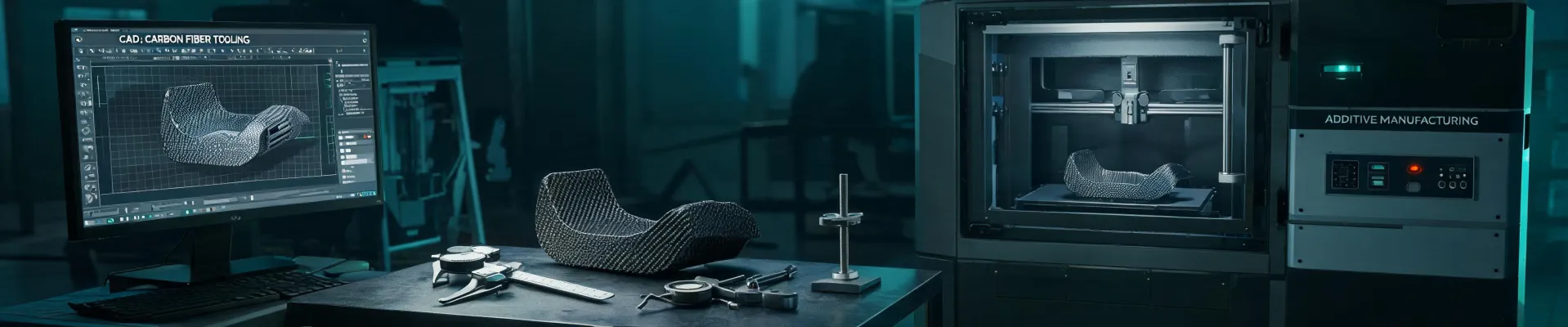
The engineer I talked to explained it in terms I could actually follow. Desktop printers use chopped carbon fiber filament. Industrial systems can use continuous fiber, which is stronger and more consistent but requires different equipment and post-processing. For our housings, they suggested printing with a carbon fiber–reinforced material and then finishing the critical surfaces on a CNC.
That combination — print first, machine after — was something I'd never considered. It solved the size problem and the surface finish problem at the same time.
2. Finishing is where the real work happens
Once the parts were printed, they went onto a VMC for cleanup. The engineer walked me through a few of the cutters they'd use. One of them was a circular milling cutter for the internal radii — I wrote it down because I had no idea what it was at the time.
Then there was the cleaning step. I asked why it mattered. He said machined aluminum parts pick up cutting fluid residue, and if you're going to bond or coat them, you need to remove it properly. Their shop used isopropyl alcohol for that, and we spent a few minutes on something I'd never thought about: the concentration.
Short version: 99% IPA is better for dissolving oils. 70% IPA has more water in it, which makes it a better disinfectant but a worse degreaser. If you're cleaning machined parts before bonding, higher concentration matters. I had assumed "alcohol is alcohol." Apparently not.
3. Not every laser can do everything
Our designer wanted the company logo engraved on the glass awards. I assumed the laser shop could handle it — lasers cut everything, right?
Wrong, at least in this case. The engineer explained that standard fiber lasers operate around 1064nm, and most glass is transparent at that wavelength. The beam passes through or shatters the surface instead of etching it cleanly. For glass, you typically need a CO2 laser (around 10.6μm, which glass absorbs) or a UV laser.
I had never thought about wavelength before. I just assumed "laser" was a single category. It's not.
carbon-3d handled the glass engraving with a different process and kept it inside the same workflow, which meant I didn't have to go find a fourth vendor.
The Result
We delivered on time. The customer innovation day went fine. Nobody at my company knew about the vendor spiral, the print failures, or the Tuesday afternoon panic. They just saw prototypes that looked good and awards that had the right logo on them.
But I knew what almost went wrong.
What I Actually Learned
I'm not an engineer. I'm still not entirely sure what a circular milling cutter does that a regular end mill doesn't. But here's what I took away from that project:
- Coordination is a hidden line item. Three cheap quotes can cost more than one slightly higher quote if you're the one holding it all together.
- Ask about capabilities, not just price. The question everyone asks is "how much per unit?" The question they should ask is "what happens after the part is made?"
- Wavelength, concentration, fiber type — these details matter. Not because I need to understand them, but because the supplier who understands them will save you from mistakes you didn't know you were making.
I still order from Bambu Lab spools for internal prototypes. Desktop printing is fine for a lot of things. It just wasn't fine for that project, and I didn't know enough to see it coming.
If I had to do it again, I'd call carbon-3d in week one instead of week two. Two weeks of my own time trying to be a manufacturing coordinator was not the efficiency win I thought it was.
Bottom line: efficiency isn't just about speed or price. It's about how many people you have to manage to get the thing done. Fewer handoffs, faster delivery, less risk. That's the version of efficiency I'm buying from now on.