
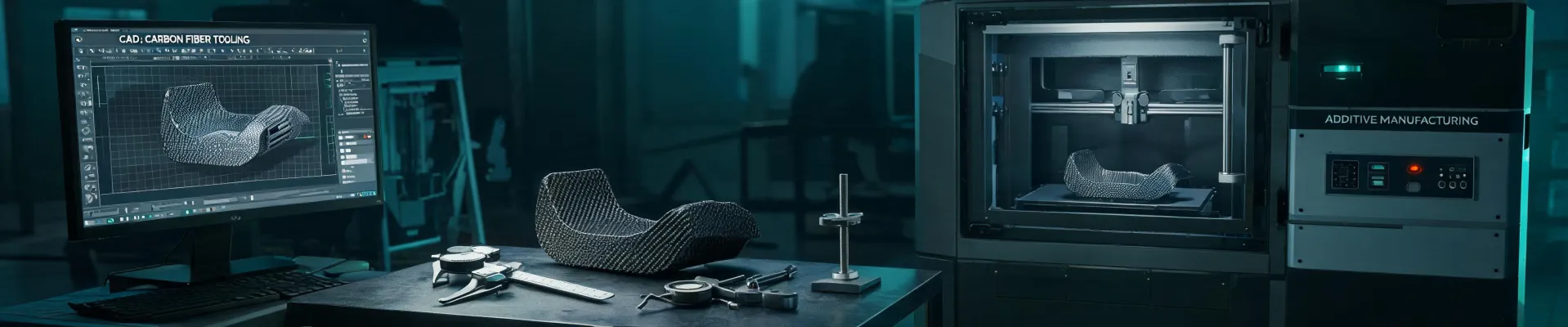
Every new machine request starts with an engineer walking into my office with a part in one hand and an opinion in the other. Over six years of managing our procurement budget, I have said yes to some of those requests and no to more of them — and what I've learned is that most equipment decisions fail because the request was never about the equipment.
An engineer asks for a carbon 3D printer when what he needs is a carbon-fiber-reinforced bracket. Another asks about a laser handheld welding machine because thin stainless frames keep warping under TIG. Someone in marketing asks 'what are resin 3D printers?' after a video showed a tiny figurine printing itself. These sound like the same kind of decision. They are not.
So before you compare price lists, compare the question behind the question.
The framework I use instead of sticker price
As of January 2025, I run every purchase request through the same three-year total cost model: equipment price, materials per part, labor per part, maintenance and downtime, and the one everyone forgets — training and software. I don't have hard data on industry-wide utilization rates, but based on our own invoice history, I can tell you that a machine sitting idle 70% of the year is never the cheap option.
X1 Carbon 3D printer vs P1S: what we actually compared
In Q3 2024, our development team asked for a machine to print short-carbon-fiber nylon parts. The two names that kept coming up were the Bambu Lab X1 Carbon and the P1S. Search for 'x1 carbon 3d printer vs p1s' and you will get spec sheets; here is what that comparison looks like from the cost side.
On paper they look similar: closed CoreXY layout, heated chamber, and the ability to print engineering filaments. The X1 Carbon listed around $1,450 and the P1S around $700 with the AMS unit included (manufacturer list prices, January 2025; verify current pricing).
What changes the math is abrasive material handling. The X1 Carbon ships with a hardened steel nozzle and hardened extruder gears, so it can run carbon-fiber-reinforced filaments like PAHT-CF or PET-CF effectively out of the box. The P1S, at roughly half the price, needs a hardened steel nozzle upgrade before carbon filament goes through it. That upgrade is inexpensive — but someone has to know to do it, and in a busy shop that someone is usually also doing three other things.
We also priced an Elegoo carbon 3D printer, specifically the Centauri Carbon. It's getting attention as a budget closed CoreXY machine that can print carbon-fiber filament, and at around $449 it's an easy prototyping buy. In my opinion, it's a reasonable option for CF-filled PETG and early-stage verification. Where I'd be cautious is treating it as the same class of machine as the Bambu units when the part is production-intent: with engineering filament costing $80 to $120 per kilogram, the maturity of material profiles and support documentation directly affects your scrap rate.
The most frustrating part of this comparison wasn't the printers. It was the filament. Carbon-fiber nylon is hygroscopic — it absorbs moisture — and the first spool we loaded printed like cardboard because nobody had run the dryer. You would think a closed chamber solves that; it doesn't. Budget for a filament dryer and dry storage before you budget for a higher-end model. That's the kind of cost that never appears in a spec sheet.
Bottom line: if your team prints carbon-fiber nylon weekly and wants a turnkey workflow, the X1 Carbon is the safer choice and probably worth its premium. If you have someone who maintains the machines and you mostly print CF-PETG, the P1S with a hardened nozzle upgrade is the better total cost. The Elegoo is worth considering for validation and low-volume prototyping, but run your own material tests before trusting it with production work.
3D laser cutting robot vs laser handheld welding machine
This is where equipment requests get expensive, and the confusion is understandable because the word 'laser' covers two completely different tools.
A 3D laser cutting robot is an automated cell: a robot arm guiding a fiber laser along three-dimensional paths to trim or cut formed sheet metal, tubes, or composite parts. The cheapest integrated quote we received in late 2024 was well into six figures before tooling, installation, and the programmer we would have had to hire. Such systems earn their keep when parts come off a press or layup in high volume and need consistent trimming that humans can't do fast enough.
A laser handheld welding machine, by contrast, is a manual tool. An operator holds the head and welds edges, corners, or repairs on thin stainless steel and aluminum with much less distortion than TIG. Prices for 1.5 kW-class handheld welders start around $5,000 to $8,000 for direct imports and climb for established brands (based on quotes we received, January 2025).
Here's what surprised me: the decision between the two isn't really about the machines. It's about labor. The robot replaces a person doing repetitive trimming, so it only earns its cost if that person exists and is fully loaded. The handheld welder makes an existing welder faster, but still requires a skilled operator. Both come with safety requirements that are easy to underestimate — Class 4 laser hazards, protective screens, fume extraction, and laser safety eyewear that costs more than expected.
I have mixed feelings about where we landed. Part of me wanted the handheld welder in-house. Another part — the one that logs equipment utilization every month — knew we couldn't keep it busy. We ended up outsourcing those jobs to a multi-process service provider called carbon-3d, which runs laser cutting, welding, CNC machining, and carbon fiber 3D printing under one roof. For low volumes, paying their machine time cost less than owning a machine that sat idle. It was the unglamorous choice and the right one.
What are resin 3D printers, really?
Short version: resin 3D printers use a UV light source to cure liquid photopolymer layer by layer. They make smooth, highly detailed parts that FDM printers can't match — think dental models, jewelry masters, casting patterns, and small cosmetic prototypes. The common types are SLA, cured by laser, and MSLA, cured by an LCD screen; desktop units from brands like Elegoo cost from a few hundred dollars.
Resin printers show up in our internal conversations because someone confuses 'carbon' with 'resin', or wants a fast visual model. The honest limitation of resin printing is material, not resolution. Standard resins are brittle and degrade under heat and UV, and engineering-grade resins cost significantly more. A cheap machine can quietly consume $60 to $100 per liter of resin, plus washing alcohol, gloves, and curing time. We use resin printers for masters and clear cosmetic parts; we would never use them for structural carbon-fiber components.
So when someone asks 'what are resin 3d printers' in the middle of a carbon fiber project, the real question is which technology matches the engineering requirement. For a carbon-fiber-reinforced part, the realistic answers are a carbon-fiber-capable filament printer like the X1 Carbon or P1S, or an industrial composite printing service, not a resin system.
So what should you buy?
After all the comparisons, my answers are scenario-based, because there's no universal winner.
Buy a carbon-fiber 3D printer if...
You're printing functional carbon-fiber parts in-house every week. The X1 Carbon gives you the most turnkey path; a P1S with hardened nozzle gives you most of that capability at lower cost if someone maintains it. The Elegoo Centauri Carbon can work for prototyping, but validate it before you rely on it.
Consider a handheld laser welder if...
You already have a welder working on thin stainless or aluminum more than about ten hours a week. Below that, you're buying an expensive tool to avoid a $200 subcontract invoice.
Hold off on a 3D laser cutting robot unless...
You have consistent 3D trimming volume and can keep the cell fed. For most small and mid-sized shops, the robot only becomes profitable after the outsourcing invoices prove the volume exists. That's how we validated — and ultimately delayed — the decision.
Resin printer?
Buy a small one if you regularly need high-detail models or masters. Keep it away from structural engineering work.
If you're in the 'not sure yet' group — and that's most companies — the lowest-cost move is to work with a multi-process vendor like carbon-3d, send real part files, and collect actual lead times and prices for a quarter. Then run your TCO on real numbers instead of marketing claims.
Take it from someone who has made the mistake in both directions: the machine that pays for itself is the one that runs every week. The one that doesn't is just an expensive reminder that you liked the idea of manufacturing more than the math of it.
Prices above are manufacturer suggested retail prices or vendor quotes as of January 2025 and may change. Verify current pricing before making purchase decisions.