
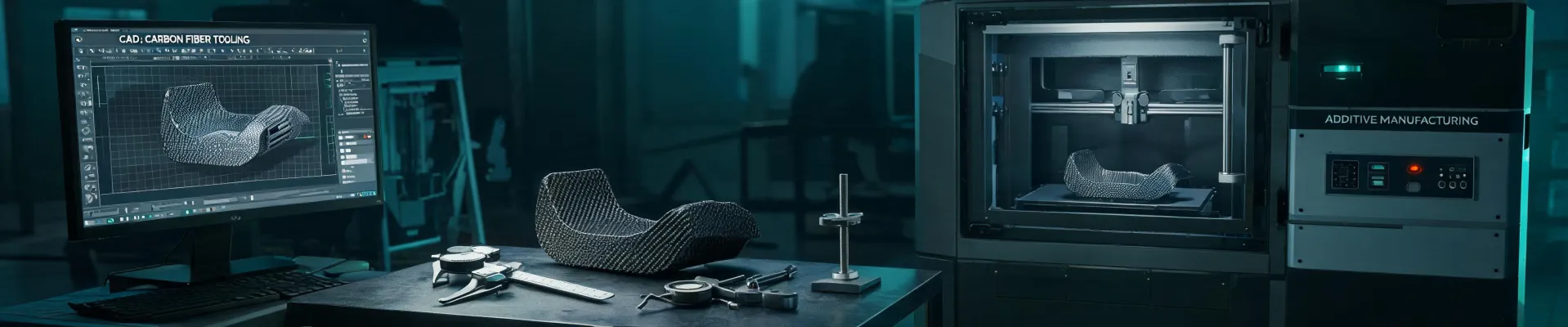
Stop treating the tensile number on a carbon fiber filament spool as a material guarantee. It is a lab measurement on one coupon, printed in one direction, under one set of conditions. It is not the strength of your part.
I’m the person who signs off on manufacturing spend at Carbon-3D. We run carbon-fiber 3D printing, CNC machining, laser cutting and welding, and injection molding. Over six years of managing procurement and costing multi-process quotes, I have tracked more than $180,000 in cumulative manufacturing spend. Customers ask me all the time, “how strong is carbon fiber 3d printer filament?” Here is the practical answer from someone whose job is to notice when a strength claim creates hidden costs.
A strength spec is only meaningful when you know the test method
Most published filament strength values are not arbitrary. They usually follow ASTM D638 or ISO 527-1: someone printed a dog-bone coupon flat, dried the material, used full infill, and pulled the coupon in a controlled lab. That is the best-case configuration for a layer-based process. It tells you how the material behaves when the print lines are aligned with the stress—not how it behaves in your geometry.
Last year we ran an internal qualification on a chopped carbon-fiber nylon used for production tooling. Printed flat in the XY orientation, the tensile strength matched what the datasheet advertised. Printed vertically, with the load pulling across the layer lines instead of along them, the measured strength dropped by almost 40%. Same spool, same printer, same material profile. The material didn’t change; the print orientation did.
If a supplier gives you one number with no mention of orientation, infill, drying procedure, layer height, or test standard, that number is directional, not contractual. This is why any “carbon 3D printer specifications” comparison that ignores print parameters should make a cost controller nervous. The machine, filament, and process are one system; you cannot pull one spec out of context.
I compare total cost, not price per kilogram
In procurement, the real question is never “which option is cheapest?” It is “which option costs least after failures, delays, inspections, and rework?” I’ve made the mistake of focusing on the per-kilo price, and the market has corrected me twice—once quietly, once expensively.
For a 2024 tooling order, we needed about 40 kg of carbon-fiber-reinforced filament. One supplier quoted roughly 18% below the product we eventually chose. On the surface, that looked like a $600 saving. But the low-cost quote included a “typical value” strength claim with no test standard and no lot traceability. Our engineering team would have had to qualify every batch, run extra coupons, and accept a failure risk that the supplier wouldn’t cover. When we priced that additional verification, the low-cost option became the high-cost option. We went with a supplier that published the test method and shipped a certificate with every spool.
Even after we made that decision, I kept second-guessing it. The difference was real money. I didn’t relax until the first three batches passed our incoming inspection and the production parts showed no variation. That is the part nobody puts on a spec sheet: the cost of confidence.
Earlier that year, I also learned not to assume “same material as last lot” means the same condition. We skipped a drying check on a rush order because, in my head, “we use this every week—what are the odds?” The odds caught up. The nylon had absorbed moisture, the prints showed steam voids and weak layer fusion, and 28 parts failed inspection. The rework cost us about $1,200 and taught me a forty-minute check is never a waste when a deadline depends on it.
Strength claims do not replace process selection
I get why carbon fiber 3D printing gets so much attention. A carbon-filled printed part can be light, stiff, and heat-resistant enough to replace a machined aluminum bracket in jigs and fixtures. For complex, low-volume parts, this technology often wins on total cost.
But I don’t buy a process because it sounds advanced. I buy the feature, the tolerance, and the load path. If a bracket needs a precisely machined bore with a tight tolerance, the most economical route may be a VMC (vertical machining center). If a sheet-metal part needs a clean edge, industrial CO2 laser cutting often beats both machining and printing. If part volume is high enough, injection molding eliminates per-part cost concerns entirely. The job of a good manufacturing partner is not to push one technology; it is to route the part where the total cost to meet the spec is lowest.
To be fair, carbon-fiber-reinforced filaments do improve stiffness and dimensional stability compared with unreinforced versions. They are genuinely useful for many parts—not because the spool says “carbon” but because the material behavior fits the application. When someone asks me how strong is carbon fiber 3d printer filament, I turn the question around: what direction is your load, what tolerance do you need, and how many parts do you need? Without those three answers, a strength number is just a conversation starter.
The objection I hear most often
“But carbon fiber filament is stronger than PLA or ABS, so it’s an automatic upgrade, right?” Not always. Stronger in one test configuration doesn’t mean stronger in every configuration. A stiff, carbon-filled part can transfer load differently than a more flexible unfilled part. If a part is going to see impact or repeated flexing, a material with lower stiffness but higher elongation can fail less dramatically. The marketing graph on the package will not show you that trade-off.
That said, in my experience, customers who make informed choices are the ones with the least rework. I’d rather spend ten minutes explaining the difference between XY and Z strength than deal with a mismatched expectation after parts are shipped. An informed customer asks better questions, approves quotes faster, and ends up paying less over the full project.
What I recommend before buying carbon fiber 3D printed parts
So, how strong is carbon fiber 3d printer filament? Used within its limits, strong enough for production tooling and functional parts. But the useful answer depends on data, not adjectives. Before you place an order, ask for:
- The test standard and coupon orientation used for each strength claim;
- a value for the weakest orientation, not just the best one;
- the drying procedure and infill settings, since both affect mechanical performance;
- a clear statement of what the supplier does if the first article does not meet the specification.
At Carbon-3D, we publish the test data for the materials we run and quote parts only after we understand the load case. That doesn’t make us the cheapest option, and sometimes it means we tell a customer that a VMC or a laser/CNC route makes more sense than 3D printing. It does reduce the expensive surprises—which, in my cost ledger, is exactly the point.