
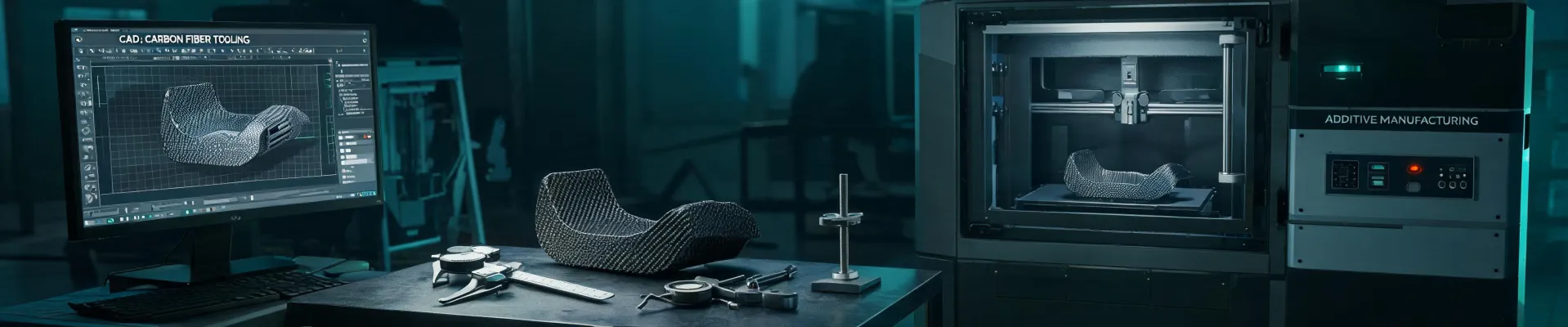
Stop asking which carbon fiber 3D printer is fastest. Ask which one will still hold tolerance after the 50th part. In my job at Carbon-3D, I review every custom-manufactured item before it ships—roughly 200 parts a year, maybe 180, I'd have to check the system. In Q1 2024, we rejected 11.8% of first-run parts because they looked right but measured wrong. Here's the conclusion you can act on: the best carbon fiber 3D printer is the one you can verify.
I'm the quality/compliance manager at Carbon-3D, a custom manufacturing company that does industrial 3D printing, CNC milling, laser cutting/welding, and injection molding. I've spent 4 years reviewing deliverables against specifications. I've stopped shipments, sent parts back for rework, and sometimes explained to a salesperson why a cosmetic flaw meant the whole batch had to be rechecked. I'm not a brand ambassador for any printer company. I'm the one who signs the part quality first.
Desktop vs industrial: Bambu X1 Carbon and the 'best' question
People often ask if the Bambu Lab X1 Carbon is the best carbon fiber 3D printer for their shop. When someone searches for 'bamboo x1 carbon 3d printer', they usually mean that machine. It is a well-built desktop printer and it can print carbon-fiber-filled filaments. In our shop, we use a similar desktop unit for quick fit checks and jigs. But I would not put a desktop printer on a production line for a safety-critical carbon fiber part. That is not an insult; it is a category difference. Desktop printers are for designers and light fixtures. Industrial systems are for qualified, production-ready parts.
I have mixed feelings about the phrase 'best carbon fiber 3D printer.' On one hand, I love that more engineers are experimenting with reinforced materials. On the other hand, a printer that makes a beautiful sample part can fail to make a consistent production batch. The machine is only one part of the equation.
What I actually check before choosing a carbon fiber 3D printer
My experience is based on roughly 200 mid-size orders a year, mostly in aerospace, automotive, and custom tooling. If you work in a completely different segment, your requirements may differ. But here are the checks I run before I trust any machine:
- Material test data. We use ASTM D638 for tensile testing on printed coupons, and ISO/ASTM 52900 for terminology. Ask any serious supplier what standard they use. If they look confused, that is a red flag.
- Repeatability across builds. Print the same geometry with the same settings at least 3 times. Measure every critical dimension. A good machine should produce the same result within a few thousandths of an inch.
- Thermal behavior. Carbon fiber reinforced parts often go through post-processing like annealing. A part that looks perfect right off the printer can warp later. We now check dimensions after every heat treatment, not just before.
- Traceability. For production parts, I need to know which material lot, which printer, which operator, and which setting file produced each batch. If a vendor cannot provide that, I cannot approve the part.
The most frustrating part of evaluating printers: every vendor prints their own test coupon with their own settings. You cannot compare material data sheets side by side because the test conditions are different. So we ask for raw data or run our own samples. Looking back, I should have asked for this data in our first vendor review. At the time, the spec sheet looked clean and the demo part looked good. It was only after we tested it ourselves that we saw the inconsistency.
What do people do with 3D printers in a real shop?
People ask what do people do with 3D printers. The stereotype is toys and display props. In manufacturing, we use them for practical things: drill templates, soft jaws, go/no-go gauges, fixtures, and low-volume production parts. One of my favorites is a work bench tool holder I designed for my own inspection station. It keeps calipers, a micrometer, and a torque wrench from rolling into the chip tray. It cost less than $10 in material and saves me more time than any commercial tool organizer I have bought.
The same mindset applies to CNC milling machine setup. Instead of waiting for a machinist to make a metal fixture, we print setup blocks, probe calibration fixtures, and soft jaws. The print is not the final product; it is the thing that makes the final product more repeatable. When setup is faster and more repeatable, the rejection rate drops.
Prevention over cure: a 45-minute inspection vs. a $22,000 redo
In 2023, we received a batch of printed brackets with a 0.3 mm flatness requirement at the mounting face. The first article looked perfect. On the coordinate measuring machine, the flatness was 0.54 mm. The parts had warped after annealing, and the warp did not show in a visual check. We caught it because we inspect first articles after every heat treatment.
That rejection led to a $22,000 rework and a two-week delay. The fix was simple: change the print orientation and slow down the cool-down schedule. The extra inspection time was about 45 minutes. The cost of not catching it would have been a field failure, an unhappy customer, and a damaged reputation.
This is the core of my prevention-over-cure bias. Five minutes of verification beats five days of correction. A checklist is the cheapest insurance you will ever buy.
When this advice might not apply
I need to be honest about boundaries. This approach worked for us because Carbon-3D is a mid-size B2B job shop with an in-house quality lab and people who read specifications for a living. If you are a one-person product studio or a hobbyist, the best carbon fiber 3D printer might be a desktop unit like the Bambu Lab X1 Carbon or another printer you can put on a shelf. You do not need a $100,000 industrial system to make a work bench tool holder.
I can only speak to manufacturing applications: aerospace, automotive, custom tooling, and low-volume replacement parts. I have not worked with medical implants, food-contact parts, or offshore supply chains. Those areas have different qualification rules, and you should verify current standards before using any checklist.
Bottom line: The best carbon fiber 3D printer is not a spec sheet hero. It is the machine and process that allow you to prove the part is right. Invest in measurement, check first articles, and put your rejection lessons back into the setup. That is how you avoid the rework that nobody budgets for.