
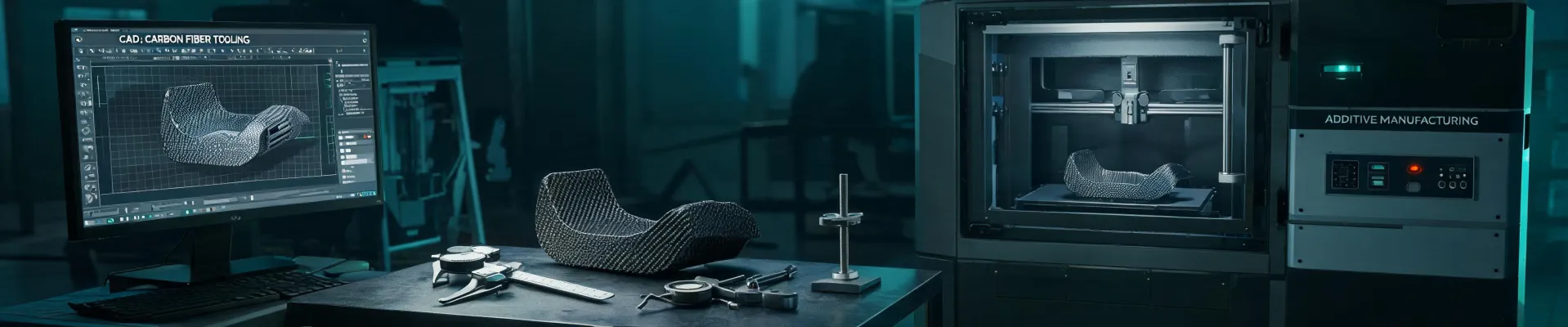
When you type "carbon fiber 3D printer cost" into a search bar, you're usually trying to answer a bigger question than the one you typed. You want to know: can I make this part, at this tolerance, in this window, without it falling apart on me later?
I coordinate rush orders at a custom manufacturing shop. Most of my days are spent triaging jobs where the deadline is short and the margin for error is zero. And in that work, I've noticed something that surprises people outside the industry: the questions that land in our inbox — about machine cost, where to buy carbon fiber filament, what counts as "metal-like," which home laser cutter to get, whether a 1-inch PVC pipe reamer is worth upgrading — these aren't six separate problems. They're six symptoms of one problem, and the problem is almost never the one people think they're solving.
Six Questions, One Underlying Decision
From the outside, these look like unrelated shopping decisions. A filament question is a consumables question. A PVC reamer is a plumbing tool. A home laser cutter is a hobbyist purchase. The carbon fiber printer cost question is a capital investment question. Different shelves in the store, different budgets, different buyers.
The reality is messier. Every one of those decisions is a link in the same chain — the chain that runs from "what the customer asked for" to "what actually ships." And when that chain breaks, it rarely breaks at the machine. It breaks at the seam.
Let me put that another way. People assume the expensive failure mode is picking the wrong printer. What they don't see is how often the failure comes from a perfectly good printer, running a perfectly reasonable material, combined with a post-processing step or a consumables choice that nobody thought of as part of the same decision.
What Carbon Fiber 3D Printer Cost Actually Buys You
The machine price is the number everyone anchors on. It's also — and I say this as someone who has watched a lot of shop budgets get approved — the least informative number in the whole calculation.
A desktop carbon fiber-capable printer sits somewhere in the four-figure range depending on build volume and enclosure. Industrial systems can run well into six figures. Those numbers are real, but they describe the entry fee, not the cost of ownership.
Based on publicly listed supplier pricing as of January 2025, carbon fiber-reinforced filament typically runs 2–4× the cost of standard PLA by weight. Verify current rates with your specific supplier — these figures move with resin and fiber supply.
What actually drives cost is what happens after the part comes off the bed. Carbon fiber filament is abrasive. It chews through standard brass nozzles, which means hardened steel or ruby nozzles, which means a different wear cycle you have to plan around. It's hygroscopic — it pulls moisture out of the air — so you need drying, storage, and a process that accounts for both. Layer adhesion behaves differently than unfilled material, which changes how you orient parts, which changes your support strategy, which changes your post-processing time. And scrap rate on carbon fiber runs higher than on plain PLA until your operators have a few hundred hours on the specific material.
None of that shows up in the printer's price tag. All of it shows up on your schedule.
To be fair, the sticker price still matters — cash flow is real, and I get why a shop hesitates on a $40,000 system. But if you're quoting a job based on machine amortization alone, you're quoting a number that won't survive contact with production.
"Metal-Like" Filament and the Spec Sheet Trap
Metal like 3D printer filament is a phrase that does a lot of quiet work. It sounds like a promise. It's closer to a category label.
These materials — usually PLA, PETG, or ABS blended with powdered copper, bronze, steel, or aluminum — are formulated so that printed parts can be sanded, polished, and oxidized to look and feel like metal. For display pieces, prop work, prototypes that need to sell a concept, and low-load cosmetic parts, they're genuinely good. We use them. Clients love how they photograph.
What they aren't is a metal replacement. The tensile strength, thermal conductivity, and electrical behavior are still polymer. The powder is mostly there for density and surface finish. And there's a second thing people miss: filled filament wears nozzles harder, prints at lower layer adhesion than the same base polymer unfilled, and gives you a much narrower window on extrusion temperature before you start seeing cosmetic banding.
The trap isn't the material. The trap is buying it based on how it's marketed rather than what it's spec'd to do. If the end use is functional — bearing load, heat transfer, electrical grounding — a metal-filled filament on a spec sheet comparison will disappoint you, and it'll disappoint you after you've already quoted the job.
Filament Sources, PVC Reamers, and Home Laser Cutters
Here's where the six searches really do collapse into one.
Buying filament is a supply-chain decision, not a purchase
When someone asks where can i buy carbon fibre 3d printer filament, they're usually looking for a link. What they should be looking for is batch consistency. The color, diameter, and fiber content of a spool can drift between production lots, and if your print profile is tuned to lot A, lot B can print visibly differently. For one-off parts, that's annoying. For a production run, it's a rework order.
Most of the shops I know that stayed small and stayed profitable did it by locking in one or two suppliers and validating every incoming lot, not by chasing the cheapest spool. That's boring advice. It's also the advice that keeps you out of weekend emergencies.
The 1-inch PVC pipe reamer is doing more work than you think
A 1 inch pvc pipe reamer exists to clean and bevel the inside edge of pipe so a joint seats properly. It's a $20 tool. It's also the exact kind of item that gets treated as an afterthought, bought from the first search result, and then quietly causes fit-up problems on a job where the pipe has to interface with a machined or printed component.
The reamer isn't the problem. The habit of treating "small tooling" as low-stakes is the problem. The last link in the chain is the one that decides whether your tolerance budget survives to final assembly.
The home laser cutter question needs a scoping statement
For what is the best laser cutter for home use, the honest answer depends entirely on what you're cutting and how repeatable it needs to be. Diode and small CO2 machines in the consumer range are genuinely capable for signage, engraving, thin acrylic, and non-critical prototyping. I don't want to trash them — half of the shops I know started on one.
The issue is precision drift. Consumer-tier machines vary in beam alignment and bed flatness more than the spec sheet suggests, and that variation shows up as kerf inconsistency. For decorative work, nobody notices. For a part that has to mate with something CNC'd or printed, kerf that's off by 0.2 mm means your joint doesn't close, and you find that out during assembly, not during cutting.
That's the same problem as the PVC reamer. Same problem as the filament lot. Same problem as buying a carbon fiber printer for its purchase price. The decision was made in isolation, and the failure showed up at the joint.
What It Costs When the Chain Breaks
Here's the part that doesn't show up in any of those search results.
In February 2024, we had a client's bracket set due for a fit-up trial in under 40 hours. First articles printed clean. The second batch came off a different spool of the same metal-filled material — same brand, same SKU, different lot — and the parts came out noticeably darker and undersized on one critical dimension. We caught it at inspection with about six hours to spare. We reprinted on a validated spool, ran the post-process, and shipped on time.
We ate about $600 in reprint and labor. The client never knew. What I remember isn't the $600. It's the two hours where I genuinely didn't know if we were going to make the deadline, and the fact that the client's design review was scheduled with their end customer the next morning.
Even after we confirmed the reprint was good, I kept second-guessing. What if the color match on the replacement parts didn't land? What if the dimensional variance was actually in the printer, not the material, and we were about to ship a second bad batch? The hours until the client confirmed receipt were stressful in a way that a $600 line item doesn't capture.
Missing that trial wouldn't have triggered a penalty clause. It would have done something worse. It would have changed how that client thought about us — from "the shop that solves problems" to "the shop that might not be ready for the next order." When I switched our incoming-inspection process from spot checks to full lot validation, the payoff wasn't fewer defects. It was that clients stopped asking whether we were sure.
Granted, lot validation costs time. It adds a step, it slows intake, and on small jobs it feels like overhead you can't afford. But the alternative is finding out at assembly — and assembly is always closer to the deadline than you want it to be.
What Actually Works
I'm not going to pretend there's a single right answer to any of the six questions at the top of this article. There isn't. But there is a right shape to the decision, and it looks like this:
- Price the process, not the product. Carbon fiber 3D printer cost includes nozzles, drying, scrap, and operator time. If a quote doesn't have those lines in it, the quote is incomplete.
- Buy consumables for consistency, not for price. The cheapest spool is only cheap until it costs you a reprint.
- Treat small tooling as part of the tolerance budget. The PVC reamer, the deburring tool, the calipers — these decide whether your tolerances hold at final fit.
- Scope what "home use" or "entry level" actually means for your job. Consumer-tier machines are excellent at what they're designed for. They're not designed for interlocking with machined components.
- Match the material label to the functional requirement. "Metal-like" is a finish. If you need metal behavior, that's a different conversation.
If managing all of that in-house sounds like a second job, that's a legitimate position. A lot of our clients came to us precisely because they got tired of chasing lot consistency, nozzle wear, and kerf drift across five separate purchases. That's the logic behind shops like ours — carbon-3d runs 3D printing, CNC, laser cutting, and injection molding under one roof, which means somebody is reconciling tolerances across processes instead of discovering the mismatch at assembly.
That's the whole point. The six questions at the top aren't six purchases. They're one decision, made carefully or made badly.
Pricing references in this article are drawn from publicly listed supplier quotes as of January 2025. Material and machine costs vary by supplier, specification, and order volume — verify current rates before budgeting.