Additive manufacturing is the process of joining materials layer by layer from a 3D model. For engineers and procurement teams with a deadline, the definition matters less than knowing when it will actually save you. In my role coordinating custom manufacturing at carbon-3d, I've handled 200+ rush orders in six years. The pattern: additive manufacturing is rarely "the future" in the abstract. It's often the fastest way out of a production hole.
What is additive manufacturing definition, in plain terms?
According to ISO/ASTM 52900:
"process of joining materials to make parts from 3D model data, usually layer upon layer, as opposed to subtractive and formative manufacturing methodologies."
In plain English: you send a digital file, the machine builds the part from powder, filament, or resin, and you get a physical object without a mold or a block of material to cut away.
If you're reading this because you need a one-paragraph answer, that's it. But the label has been messy. People used to call it "rapid prototyping" because that was its only real use. By 2025, that framing is outdated. Additive manufacturing is used for production parts, custom tooling, medical implants, and urgent replacements. The fundamentals haven't changed—you still need a good file, a suitable material, and a process that fits the part. The execution has transformed.
How I learned that process selection is a deadline decision
It took me three years and about 150 orders to understand that choosing between 3D printing, CNC machining, and injection molding isn't about "best." It's about fit. A complex bracket with internal channels? Additive manufacturing is probably your quickest route. A flat aluminum plate with tight hole tolerances? CNC machining wins. Ten thousand identical clips? Injection molding is the only sane choice.
In March 2024, a client called at 1 p.m. needing a carbon-fiber-reinforced bracket for a product demo the next day at 4 p.m. Normal lead time was five days. We used additive manufacturing for the first iteration, tested it, then CNC machined a final metal bracket overnight. The rush fee was $400 on top of a $1,400 base cost. The client's alternative was missing the demo and triggering a penalty payment. The bracket worked. The lesson stuck.
The most frustrating part of rush production? The same mistakes keep coming back. You'd think a purchase order with "URGENT" in red would get people moving, but it often creates panic instead of priority. What finally helped was building buffer time into every quote. If the client needed it Friday, we promised Thursday. Simple.
Where the Bambu Lab X1-Carbon fits
If you've been searching for a Bambu Lab X1-Carbon combo 3D printer, or the slightly different phrasing X1 Carbon Bambu Labs 3D printer, you're looking at the consumer/hobbyist end of additive manufacturing. These machines are fast, enclosed, and can print carbon-fiber-reinforced filaments. For learning the core concepts, they're genuinely useful.
Here's the thing: a desktop printer is not a production line. There's a gap between "can print carbon fiber filament" and "can manufacture a carbon-fiber part with documented properties." That's not a knock on the machine; it's a boundary. Industrial additive manufacturing is about repeatability, material certification, and quality systems. A desktop printer can give you a prototype. It can't always give you a production part with traceability.
Why does this matter? Because the definition of additive manufacturing includes both ends of the spectrum. If you ignore the differences, you might make the same mistake I made early on: choosing a machine because it's popular instead of a process because it's reliable.
The irrelevant searches that still show up
Not everyone who lands on a manufacturing website is looking for manufacturing. For example, CO2 laser on tummy tuck scar. In medicine, a fractional CO2 laser is used for scar revision. In manufacturing, a CO2 laser cuts and engraves materials. Same term, entirely different field. We use CO2 lasers for cutting sheet materials, not for treating surgery scars.
Another one: nettoyage gaine VMC simple flux—French for cleaning a single-flow ventilation duct. I'm not going to pretend additive manufacturing will clean your ducts. It won't. But that search shows up, and it's worth explaining why: search intent matters. The word "flux" sounds like someone in a factory, but the problem is HVAC maintenance. Same lesson applies to engineers. Ask the question behind the request before quoting a process.
If you're in procurement, you've probably seen mismatched search terms too. They're a reminder that the person typing a request isn't always the person who understands the process. That's why I always ask the same thing when a rush order comes in: not "which process do you want?" but "what problem are you solving?" The process follows from that.
When additive manufacturing is not the answer
Additive manufacturing loses its edge when you need 10,000 identical parts and a very low unit cost. Injection molding takes over there. It also struggles when you need tight tolerances in high-strength metal; CNC machining is the standard. Additive manufacturing is strongest for complex geometry, low-volume production, custom tooling, and urgent replacements.
Before you pick a process, ask four questions: How many parts do you need? What are the critical dimensions? What material properties are actually required? And when does the part need to be in your hand? The last question is often the one that makes additive manufacturing worth considering.
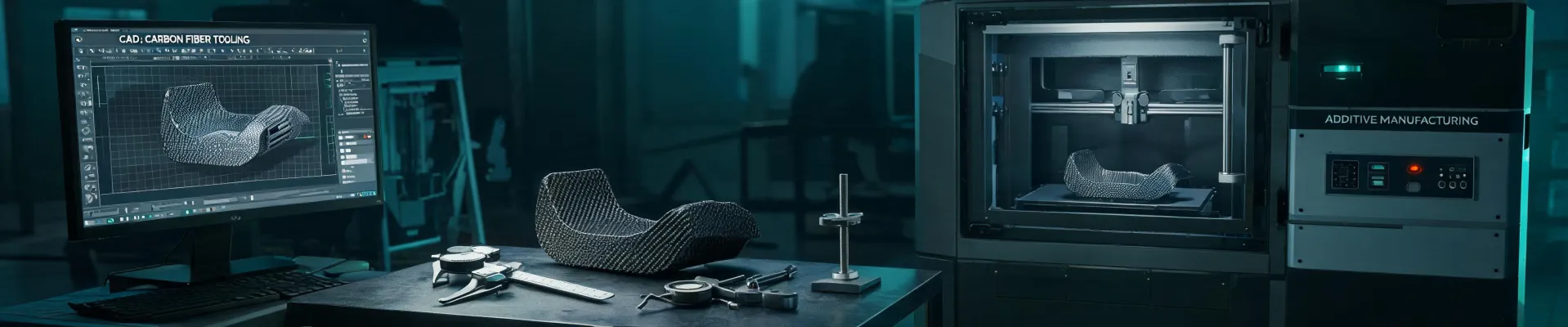
Carbon-fiber 3D printing is one of the areas where that tradeoff has shifted since 2020. The materials are better, the printers are faster, and the parts are strong enough for many functional applications. But "strong enough" depends on the application. A carbon-fiber reinforced bracket for a demo is not the same as a certified aerospace component.
I have mixed feelings about rush fees. Part of me thinks they're a tax on bad planning. Another part has watched an operator run a machine overnight, a quality tech come in early, and a courier hold a flight. Maybe the fee is fair. In my experience, what matters more is honesty. If a supplier says "I can't do that," that's better than a promise followed by silence.
Look, I'm not saying additive manufacturing is always the answer. It's often the least-bad option when time is the constraint. In 2024, our team processed 47 rush orders with a 95% on-time delivery rate. Twenty-nine of those used additive manufacturing for at least one step. That's a data point, not a universal law. If you have a part that needs to exist in 48 hours, start with a clear definition of the problem, then ask a manufacturer with real capacity whether additive manufacturing can get you there.