
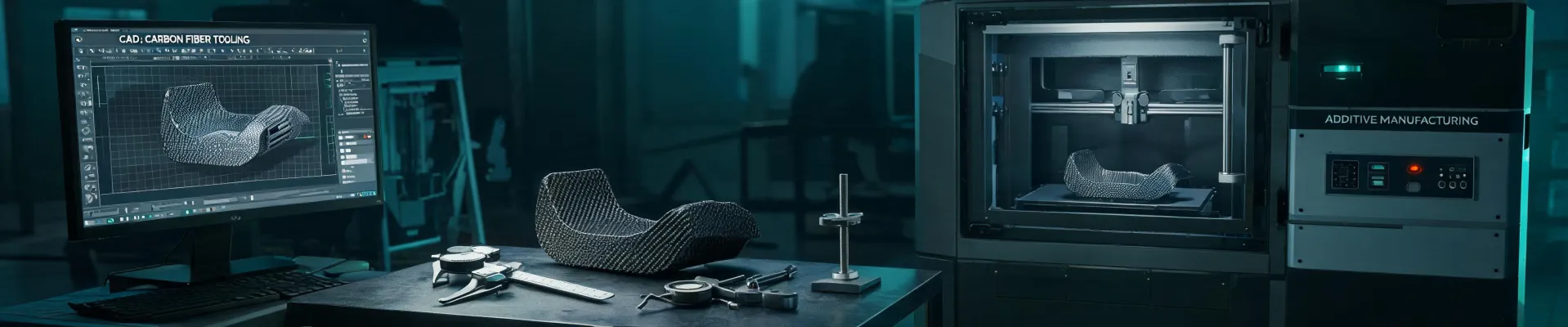
Three Processes, One Deadline
I coordinate rush manufacturing orders at carbon-3d, an advanced manufacturing provider that handles carbon fiber 3D printing, CNC machining, and laser processing under one roof. When a client calls with 48 hours on the clock, I don't have time to think in theory. I need to know whether the part gets printed in carbon fiber filament, machined on a vertical machining center, or joined with a laser beam — and I need to know fast.
This article compares those three process families head-to-head across the dimensions that actually determine rush order success: turnaround time, precision, material behavior, and application fit. No brand loyalty here. Just what works when the clock is running.
Round One: Time to Part — 3D Printing vs CNC Setup
Let's start with the number one question I get from engineers: "Which is faster — a carbon fiber 3D printer or a CNC machine?" The honest answer: it depends on how many parts you need and what the geometry looks like.
Take the Bambu Lab X1-Carbon, which is the most common carbon fiber-compatible printer I see in our workflow. Specs that matter for rush orders:
- Build volume: 256 × 256 × 256 mm
- Layer height: 0.08–0.2 mm
- Max print speed: up to 500 mm/s
- Nozzle temperature: up to 300°C (hardened steel nozzle)
- Enclosed heated chamber — essential for PA-CF and other engineering filaments
A PA-CF bracket with decent wall thickness runs maybe 6–8 hours on that machine. You prep the file, slice it, and press print. Total hands-on time: under an hour. That machine handles carbon fiber reinforced filament (PA-CF, PETG-CF, PLA-CF) without complaint, though I always recommend the hardened nozzle for anything with abrasive fillers.
Now the high precision vertical machining center. A typical machine with a BT-40 spindle and 10,000–15,000 RPM. Before the first chip comes off, you need CAM programming, stock setup, fixture selection, tooling decisions. That's 2–4 hours of engineering time before cutting even starts. Once it's running, though, you're cutting aluminum at 200+ IPM with positioning accuracy around ±0.005 mm.
When I compared our rush order data side by side — 3D printed parts vs machined parts over a full year — I finally understood why the comparison wasn't as simple as "one is faster." For a single part, 3D printing almost always gets there first. For 50 identical parts, the machining center's setup cost gets amortized fast, and it'll outrun the printer by end of day.
Not what most clients expect. But it's what the data shows.
Round Two: Precision — When Microns Actually Matter
Here's where CNC machining pulls ahead, and I don't think any honest person in this industry will tell you otherwise. A high-precision vertical machining center holds ±0.005 mm positioning and ±0.002 mm repeatability. A 3D printer like the X1-Carbon gives you roughly ±0.1–0.2 mm tolerance on a good day, depending on geometry, material shrinkage, and cooling behavior.
The most frustrating part of my job: clients specifying ±0.01 mm on a snap-fit housing that functionally only needs ±0.2 mm. You'd think engineers would know the difference between "machine capability" and "requirement," but the two get conflated constantly.
Why does this matter? Because tolerance drives cost and lead time. If you demand machining tolerance on a 3D-printed part, you're either paying for CNC anyway or setting yourself up for a failed inspection. If you actually need precision — bearing seats, guide rails, mating surfaces — don't waste hours trying to make 3D printing do something it's not going to do. Send it to the machining center.
But then again: the reverse is also true. Plenty of parts in a typical rush order don't need that level of precision at all. A cover, a fixture, a bracket — ±0.2 mm is fine. Choosing CNC for those parts wastes exactly the resource you don't have: hours.
Round Three: Materials — Carbon Fiber Filament vs Machined Stock
This is the part that catches people off guard. There's a big difference between carbon fiber reinforced filament and a solid carbon fiber layup or a machined carbon fiber composite block. The filament version contains short carbon fibers suspended in a thermoplastic matrix — PA, PETG, or PLA. It's stiffer and more dimensionally stable than the base plastic, and it handles heat better. But it is not the same material as an aerospace-grade laminate.
Here's what you need to know: the term "carbon fiber" on a filament spool means the material has chopped carbon fibers in it. It gives you high stiffness-to-weight and excellent wall stability for 3D printing. What it won't give you is isotropic strength in all directions. The Z-axis layer adhesion is always the weak link — everyone who's snapped a PA-CF part along a layer line knows exactly what I'm talking about.
Machined stock — aluminum 6061, steel, Delrin — has datasheet properties. You know the yield strength, you know the anisotropy (or lack of it), and you can design with confidence. For structural loads in a rush scenario, I'd rather trust a machined part than a printed one. The stakes are too high to gamble on layer adhesion.
One more layer to this. Per the FTC's Green Guides (16 CFR Part 260), a product claimed as "recyclable" needs substantiation — it should actually be recyclable where a meaningful portion of consumers have access to recycling facilities. That standard of proof is a good bar for any material claim, including carbon fiber marketing. When a supplier tells you their filament is "aerospace-grade carbon fiber," ask for the datasheet. If they can't produce one, treat the claim as marketing, not engineering.
I don't have hard data on how many clients actually need true structural carbon fiber versus the reinforced filament, but based on seven years of rush orders, my sense is that 80% of "carbon fiber" requests would be fine with PA-CF printed parts. The other 20% need something machined from real composite or metal — and they usually know it.
Round Four: Laser Beam Welding — When Joining Is the Bottleneck
Sometimes the part isn't the problem. The problem is two parts need to become one — and they need to do it today. That's where laser beam welding enters the rush order conversation.
When clients research laser beam welding, the question I hear most is: "IPL laser vs CO2 — which is better?" Let me clear up the terminology, because the question usually contains a misunderstanding. Strictly speaking, IPL (intense pulsed light) is a broadband light source, not a true laser. In industrial contexts — especially when people are reading translated specs or buying equipment from overseas — the term "IPL laser" almost always means a pulsed solid-state or fiber laser operating around 1.06 μm wavelength. So the real comparison is pulsed fiber lasers vs CO2 lasers.
Here are the differences that matter for a job shop:
- CO2 lasers (10.6 μm wavelength): higher heat input, lower electrical efficiency (~10–15%), more consumables, better suited for thicker carbon steel sections.
- Pulsed fiber lasers (1.06 μm): higher efficiency (~30%+), smaller spot size, less heat-affected zone, and they handle reflective metals like aluminum and copper far better — a CO2 beam reflects off those materials like it's hitting a mirror.
I only fully appreciated the wavelength issue after ignoring it once. In March 2024, we quoted a thin aluminum enclosure welding job and ran it on our CO2 source because it was free and the client needed the part in 24 hours. The weld was weak and inconsistent. The inspection report told us what we already knew: wrong tool for the material. We switched to a pulsed fiber source, re-ran the weld in three hours, and made the deadline. The client's alternative was a failed quality audit and a penalty clause worth roughly five times the job value.
For most rush welding scenarios — thin sheets, aluminum, stainless — pulsed fiber lasers are my default. CO2 still has a place for thicker steel, but I've watched its share of new industrial laser sales decline every year since 2016. If you're building your own welding capability, the trend line is clear.
So: Which Do You Choose?
There's no universal winner between carbon fiber 3D printing, CNC machining, and laser welding — only matches between process and requirement.
Here's how I actually make the call when the clock is running:
- Single prototype or small run, complex geometry, 24-hour deadline: carbon fiber 3D printing on an X1-Carbon or similar. Last March, I had a client needing twelve PA-CF brackets for a trade show the next morning. We printed them overnight and couriered them by 7 AM. Their alternative was losing a $12,000 exhibit placement.
- Precision components, tolerances under ±0.05 mm: high-precision vertical machining center. No question. Programming time is worth the investment if dimensional accuracy is non-negotiable.
- Thin-gauge aluminum or stainless that needs joining: pulsed fiber laser welding. Minimal heat-affected zone, fast travel speeds, reliable results.
- Production runs of 50+ parts: CNC machining, regardless of geometry. Setup cost gets distributed, and per-part cycle time is brutal for any 3D printer.
One thing I remind every client: shipping is the cheapest part of the rush. According to USPS pricing effective January 2025, a First-Class Mail large envelope costs $1.50. Even overnight courier fees, which run $30–80, are small next to the cost of picking the wrong manufacturing process and paying for a redo.
The expensive move isn't choosing 3D printing over CNC. It's choosing without understanding the trade-offs, then paying overnight fees twice because the part didn't meet spec. Know what your part actually needs, and the decision gets much easier.
Bottom Line
There's no universal winner here — only matches between process and requirement. My job is to help clients understand those requirements before the deadline starts shrinking. An informed customer asks better questions, makes faster decisions, and doesn't call me at midnight asking why the part doesn't fit. That's the whole trick. Everything else is just cutting, melting, or depositing material — fast enough to catch the courier.