-
Four Scenarios, One Framework
-
Scenario A: Complex Geometry + Carbon Fiber → Carbon Fiber 3D Printing
-
Scenario B: Round Parts + Volume → CNC Turning
-
Scenario C: Non-Round Parts + Tight Tolerances → CNC Milling
-
Scenario D: Flat Sheet Stock + Cutouts → ISO-Certified Laser Cutting
-
How to Figure Out Which Scenario You're In
-
Still Not Sure? Get Two or Three Quotes and Ask One Question
If you typed "what 3D printer can print carbon fiber" or "CNC milling vs CNC turning" into a search bar, you're probably holding a part drawing and trying to figure out how to get it made. I'll save you some reading: there is no single right answer. The best process depends on what the part needs to do, how many you need, how tight the tolerances are, and when you need it on the dock.
I've spent five years handling purchasing for a small manufacturing company — roughly 50 custom parts orders a year across 3D printing, CNC machining, laser cutting, and injection molding vendors. I'm not an engineer; I'm the person who turns engineering drawings into purchase orders. The framework below is the one I use, developed through a few costly mistakes.
Four Scenarios, One Framework
Every part request I see falls into four buckets:
- Complex geometry, carbon fiber material, low-to-mid volume → carbon fiber 3D printing
- Cylindrical or symmetrical geometry, mid-to-high volume → CNC turning
- Prismatic (non-round) geometry, tight tolerances → CNC milling
- Flat sheet stock with cutouts or holes → laser cutting
If your part doesn't clearly fit one of these, it's usually because you haven't pinned down five things yet: geometry, material, volume, tolerance, and deadline. Straighten those out and the process choice gets much simpler.
Scenario A: Complex Geometry + Carbon Fiber → Carbon Fiber 3D Printing
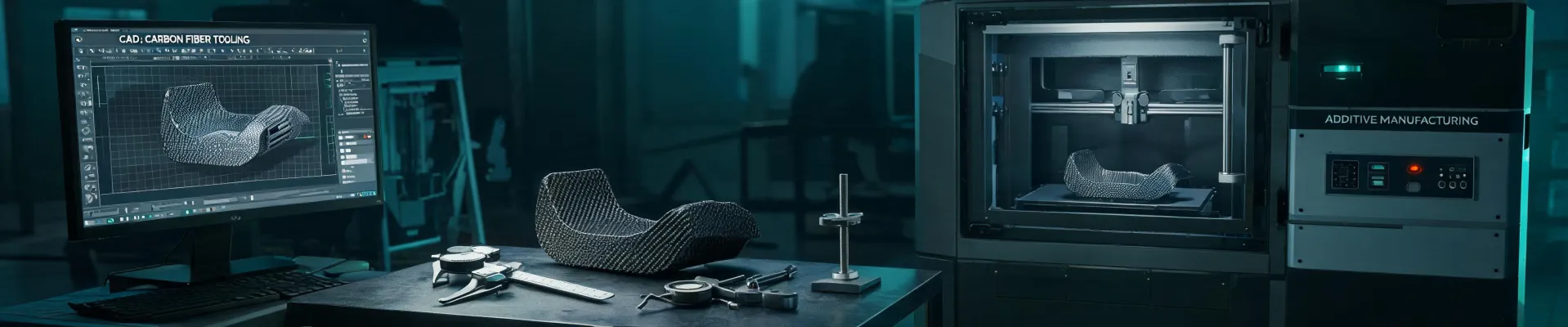
The question of what 3D printer can print carbon fiber comes up constantly. The short answer: a printer built to handle abrasive materials. Carbon fiber filament will tear up a standard brass nozzle in a matter of hours. You need hardened steel or ruby-tipped nozzles, a direct-drive extruder to reliably push the stiffer filament, and a heated chamber helps with layer adhesion on materials like nylon-carbon composites.
Industrial options like the Carbon L1 3D printer are designed for exactly this job. It's a serious piece of equipment — closed parameters, reinforced materials, and parts with consistent mechanical properties. But here's the part I have to gently explain to our engineers: we need parts, not a printer. Unless you're doing this every single day, buying an expensive industrial machine and qualifying materials is a heavy lift. That's why we typically use a 3D printing service (like carbon-3d, in our case) rather than buying hardware.
Choose carbon fiber 3D printing when:
- The part has internal channels, lattices, or organic contours you can't machine out of solid stock
- You need carbon fiber's stiffness-to-weight ratio without the tooling cost of molded carbon composites
- Quantities are under roughly 100 units — past that, injection molding or another process often wins on per-part cost
- You expect design revisions; digital iteration doesn't require new tooling or a CAM rework
One counter-intuitive point: carbon fiber 3D printing isn't just for prototypes anymore. With industrial-grade equipment, you can get parts strong enough for end-use in jigs, brackets, and housings. But it's not the right choice for parts with tight tolerances (below ±0.1 mm) — that's where machining takes over.
Scenario B: Round Parts + Volume → CNC Turning
Of all the questions I get, "CNC milling vs CNC turning" is the most confusing for new buyers. The difference is simpler than it sounds:
- Milling: the cutting tool spins, the part stays still. Good for flat surfaces, slots, pockets, holes, and complex 3D shapes.
- Turning: the part spins, the cutting tool stays still. Good for anything with an axis of rotation — shafts, bushings, fittings, pulleys.
Here's where I push back on the "just machine it" mindset: for round parts, CNC turning is usually the smarter and cheaper option. A CNC lathe can crank out simple round parts in seconds per piece, with surface finishes that are hard to match on a mill. I once got a quote for a brass bushing that was nearly identical to the price of a machined plate part — except the turning quote included 300 pieces in the same lead time. When the part fits on a lathe, turn it. Don't ask a milling shop to do it the expensive way.
The exception: parts that are mostly round but carry significant non-round features — flats, holes at odd angles, complex pockets. If a large portion of the machine time involves secondary milling operations, a full CNC milling approach (or turning with live tooling) may be better. My rule of thumb: if the non-round features are more than a couple of flats or cross-holes, get quoted for both and let the numbers decide.
Scenario C: Non-Round Parts + Tight Tolerances → CNC Milling
When the print calls out tight tolerances — say ±0.005 inch or tighter — 3D printing and laser cutting drop off the list. CNC milling is the workhorse. It handles housings, brackets, mounting plates, blocks, and anything with a flat reference surface or precise hole positions. It's also the most forgiving in terms of material choices: 6061 aluminum for structural parts, stainless steel when corrosion or heat matters, and engineering plastics like Delrin or PTFE when low friction is key.
What I've learned the hard way on milling: the shop's experience with your material matters as much as their machine count. I once sent a polycarbonate part to a vendor who quoted confidently and then struggled with cracking and warping. Two rework cycles later, we switched to a shop that specializes in plastics and the parts came out fine. The machine is a tool; the machinist's judgment is the real product.
My experience here is based on milled parts up to about 12 inches in size, in quantities from 1 to 500. If you're working with massive plates or 10,000-unit production runs, your cost structure will look completely different.
One hybrid approach worth knowing: for complex parts where only a few features require tight tolerance, we sometimes 3D print the shape and CNC machine just the critical surfaces afterward. That's typically 20-30% cheaper than full machining when the geometry is complex but tolerance-critical features are limited.
Scenario D: Flat Sheet Stock + Cutouts → ISO-Certified Laser Cutting
If your part is flat — sheet metal panels, gussets, mounting plates, decorative panels with cutouts — laser cutting is the fastest way to get there. It produces clean square edges, a narrow kerf (roughly 0.15-0.3 mm, better than plasma or waterjet for thin material), and it's quick. Most laser shops can turn flat parts around in a few days, often twice as fast as an equivalent 3D print.
Now, about "ISO certified laser cutting" — that phrase gets thrown around enough that it deserves unpacking. ISO 9001:2015 is the quality management system standard. It requires documented procedures for equipment calibration, material traceability, non-conformance handling, and continuous improvement. When I evaluate a laser cutting vendor, that certification matters because it signals that their machines are on a calibration schedule, that they track tolerances, and that they'll actually fill out paperwork when something goes wrong. That last part (ugh) has saved me more than once when a customer asked for proof of process control.
Things to ask a laser cutting vendor before sending over your PO number:
- What's their standard tolerance? A good shop will tell you ±0.005" or better for most thin metals.
- Do they deburr or tumble parts after cutting? Sharp edges are a safety issue — and a packaging nightmare.
- Can they handle your material? Most do mild steel, stainless, and aluminum. Some handle copper, brass, and specialty alloys.
- Do they hold ISO 9001:2015 certification? If no, ask why.
And yes, location matters for the logistical side. If you're in Phoenix, AZ and searching for 3D printing services or laser cutting nearby, local vendors have a real advantage: no shipping wait, and you can physically inspect parts before accepting the order. I've used that to catch a tolerance issue on the spot — much easier than emailing photos back and forth.
How to Figure Out Which Scenario You're In
Let's make this practical. Run your part through this checklist:
- Shape. Is it round and symmetrical? → CNC turning. Non-round, boxy, prismatic? → CNC milling. Flat and thin? → Laser cutting. Complex internal geometry? → 3D printing.
- Tolerance. Tightest callout under ±0.13 mm (±0.005")? 3D printing and laser cutting are usually out. CNC milling or turning only.
- Material. Carbon fiber required? → 3D printing. Aluminum or steel? → CNC (or laser, for sheet stock).
- Volume. Under ~20 units → 3D printing usually wins for complex parts. 100+ round parts → turning gets cheap. 500+ flat parts → laser cutting dominates.
- Deadline. This is the one everyone underrates: when the date on the calendar is non-negotiable, pay for certainty.
That last point deserves emphasis, because it's cost me the most over the years. In March 2024, we paid an extra $400 for rush laser cutting on a $1,800 parts order. Without it, we would have missed a compliance deadline that carried a $15,000 penalty. That $400 was the best deal of the year.
"The part is only cheap if it shows up when you need it," our operations manager reminded me after that incident.
Rush charges buy certainty, not just speed. A vendor who commits to a 48-hour turnaround is telling you where your part sits in their queue and how confident they are in their own scheduling. If a shop won't commit to a date for standard work, they won't magically come through when you're in a bind.
Look, I'm not saying you should always pay rush fees. For prototypes and parts the team can wait on, standard turnaround is fine — there's something satisfying about a normally scheduled order arriving without any drama. But when a deadline has a dollar amount attached, treat the rush fee as part of the cost of doing business, not as an upsell to resist.
Still Not Sure? Get Two or Three Quotes and Ask One Question
At the end of the day, the fastest way to determine the right process is to ask vendors. Send the part file to a 3D printing service, a CNC shop, and a laser cutting provider. Then ask each one: "If your process is the wrong fit, please tell me." The vendor that recommends against themselves earns trust instantly. I've stayed with our current manufacturing partners for four years partly because one of them told me on the first call: "You don't want us for this one. Here's who you should call."
My experience is based on mid-sized orders in a fairly standard range — nothing exotic. If you're working with massive production quantities or aerospace-grade materials, the economics will shift. But the framework holds: pin down the requirements first, match them to the process, and put a real number on your deadline. That's the whole secret, and it's saved our team a lot of expensive mistakes.