
-
Who Should Use This Checklist
-
Step 1: Start with the part, not the process
-
Step 2: Define the material—including carbon fiber for 3D printer filament
-
Step 3: Ask for setup fees, file prep, and "free" revisions
-
Step 4: Verify capability claims—machine names aren't enough
-
Step 5: Ask the "dumb" machining question—can you use an end mill to drill a hole?
-
Step 6: Budget for tooling and consumables—even the boring stuff
-
Step 7: Put every quote in a TCO sheet
- Common Mistakes I Still See
-
Bottom Line
If you've ever compared quotes for a machined or printed part and felt like you were comparing two different languages, this checklist is for you. It's not about "always pick the cheapest" or "always pick the most expensive." It's about catching what the quote doesn't say.
I'm a procurement manager at a 40-person custom parts company. I've managed our outsourcing budget—about $180,000 a year—for six years, negotiated with 30+ vendors, and documented every order in our cost tracking system. This is the checklist I run through when I evaluate carbon fiber 3D printing, CNC milling, laser cutting, and injection molding quotes.
One thing before we start: what was best practice in 2020 may not apply in 2025. The fundamentals haven't changed—specs, price, lead time, trust—but the execution has transformed. Multi-process suppliers are more common, machine capabilities have shifted, and some "rules" I was taught early on have not aged well.
Who Should Use This Checklist
Use this if you're buying custom parts for a business, not just selecting a desktop printer for a hobby room. It also works if you're in the middle of a vendor search for Dallas precision CNC milling services or trying to decide whether to print a carbon fiber part or machine it. It's written for the person who has to justify the decision later.
There are 7 steps. Most are quick. One of them will look too simple to matter—that's probably the one that saves you money.
Step 1: Start with the part, not the process
It's tempting to think that carbon fiber 3D printing is always the "advanced" choice and CNC milling is "traditional." That's a false split. I've printed parts that should have been machined and machined parts that should have been printed. The cheapest option is the one that meets the actual requirement: strength, dimensional tolerance, thermal exposure, surface finish, and quantity.
When I ask a team "what's the part for?" I'm not being difficult. A bracket that holds a sensor in a lab does not need the same process as a production jig that gets banged around a shop floor. Write the operating conditions down before you ask for quotes.
Step 2: Define the material—including carbon fiber for 3D printer filament
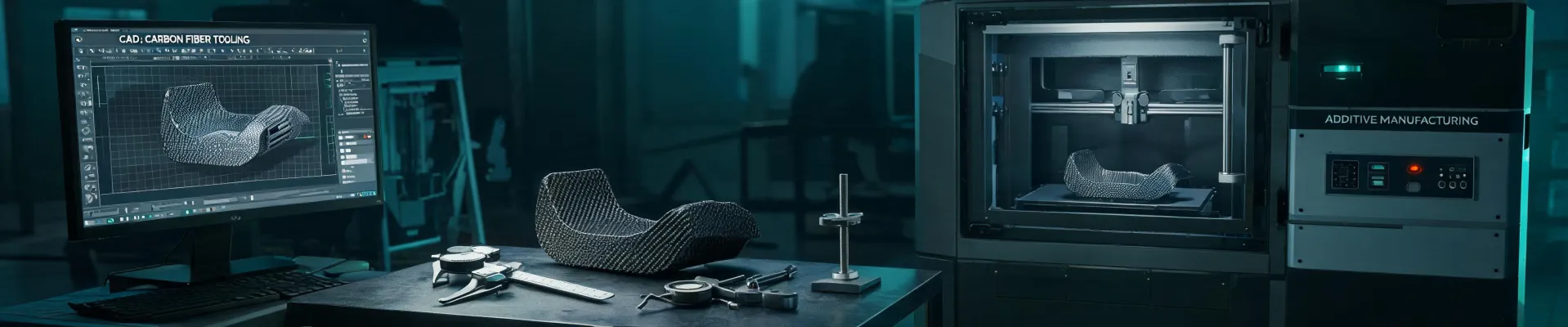
Here's where a lot of quote confusion starts. If you're looking at carbon fiber for 3D printer filament, get specific. Is it a short-fiber-filled filament like CF-PETG or CF-PA? Is it a continuous carbon fiber layup? These are not interchangeable, and the cost difference is huge.
A quick example: buying a desktop carbon fiber 3D printer like the Bambu Lab X1-Carbon combo 3D printer is a reasonable option for some prototyping work. The "carbon" in the name means it can handle carbon-fiber-reinforced filament. That is not the same as continuous carbon fiber 3D printing for functional production parts. Both have their place, but if you use the wrong one, you'll get a part that fails or a quote that's way too high.
For CNC, specify alloy, temper, and finish. For injection molding, specify resin grade and filler content. "Plastic" or "carbon" is not enough.
Step 3: Ask for setup fees, file prep, and "free" revisions
This is where I've been burned. A vendor once offered "free setup" on a $4,200 order. (Should mention: it was a vendor we'd already used for years, so it felt like a loyalty perk.) What I missed was a $450 programming charge buried under "part preparation." The setup was free. The prep wasn't.
When comparing quotes, ask each supplier for a simple cost breakdown: material, machine time, labor, setup, tooling, shipping, and tax. If they won't give it, that's a red flag. Not because they're hiding something, but because you can't compare apples to apples.
Also ask: is the revision included? Does a small model change trigger a new quote? I've seen a $30 file tweak turn into a $200 change order.
Step 4: Verify capability claims—machine names aren't enough
If someone says they have a "precision CNC shop," that doesn't tell you how tight they can hold. If they advertise Dallas precision CNC milling services but can't show you inspection reports from similar parts, keep looking.
Same with 3D printers. A machine like the Bambu Lab X1-Carbon combo 3D printer is a capable tool, but the operator matters more than the machine name. Ask about build volume, chamber temperature, layer height, and calibration history. For carbon fiber reinforced materials, ask how they dry the filament and how they handle nozzle wear. Those details decide whether you get a solid part or a stringy mess.
Oh, and one more thing: if a vendor says "we can do anything," ask for examples. A generalist can be great. A specialist who knows when to say no is often more valuable.
Step 5: Ask the "dumb" machining question—can you use an end mill to drill a hole?
If you've ever wondered this, you're not alone. The short answer: yes, but only with the right end mill and the right method. A center-cutting end mill can plunge axially and start a hole. A standard end mill that isn't center-cutting won't plunge reliably, and using it like a drill bit is a quick way to break a tool.
But the deeper point is this: the question matters because process feedback matters. When you send a part to a machine shop, you want the person doing the quoting to notice when your drawing calls for an operation that doesn't match the tooling. If they don't flag it, you'll learn about it later—usually after the part is late.
Put another way: "can you use an end mill to drill a hole" is one of those questions that separates a parts vendor from a manufacturing partner. A partner tells you, "you could, but a spot drill and drill bit will be faster and cheaper at this quantity."
Step 6: Budget for tooling and consumables—even the boring stuff
This one seems too minor to matter. It isn't. A magnetic tool holder set costs maybe $30 to $60, and I initially treated it as a "nice to have." Then we lost two carbide end mills in a week because they rolled off the bench into the chip bin. That was a $90 lesson. We bought the magnetic tool holder set and stopped paying that tax.
If you're setting up your own small manufacturing cell, don't just budget for the CNC machine or 3D printer. Budget for end mills, collets, wipers, calipers, dry boxes, filament storage, and a magnetic tool holder set. In a production environment, the tooling budget can quietly outrun the machine payment.
Step 7: Put every quote in a TCO sheet
It's tempting to think you can compare unit prices. But identical specs from different vendors can result in wildly different outcomes. The conventional "always get three quotes" advice ignores the transaction cost of evaluating new vendors and the value of existing relationships. In practice, I've found that relationship consistency often beats marginal cost savings.
I built a cost calculator after getting burned on hidden fees twice. Now every quote goes into the same columns: unit price, setup, tooling, shipping, inspection, estimated scrap rate, lead time, and vendor responsiveness. In Q2 2024—if I remember the exact number right—that spreadsheet told me we could save about $8,400 a year by switching one supplier. It was 17% of our budget, and I wouldn't have seen it if I'd only looked at unit price.
If you're comparing a multi-process supplier like carbon-3d against a single-process shop, the TCO sheet is where the comparison actually happens. One supplier might have a higher hourly rate but no shipping gap between printing and machining. That can be a no-brainer if it removes a week of lead time.
Common Mistakes I Still See
I've made most of these at some point. Here are the ones I still see.
Mistake 1: Treating "compliance" as a marketing word
If a supplier says "aerospace-grade" or "defect-free," ask them to substantiate it. The FTC's advertising guidelines (ftc.gov/business-guidance/advertising-marketing) say claims have to be truthful, not misleading, and backed by evidence. I'm not a lawyer, but I've used that page to push back on vague quality promises. If a claim makes it into a contract, fine. If it's just in the sales email, it's worth a follow-up question.
Mistake 2: Ignoring scrap rate when comparing carbon fiber 3D printing to CNC
Printed parts can warp. Machined parts can cut thin. Both processes have scrap. When I audited our 2023 spending, I found that a lot of our overruns came from rework, not from the initial quote. It's tempting to assume scrap is factored into the unit price. It usually isn't. Ask, "What percentage of parts need rework before shipping?" If the vendor says "1%," ask how they track it. Don't hold them to a perfect number, but the answer should not be "we don't really measure that."
Mistake 3: Choosing the cheap option without counting the redo
We once chose a low-cost shop for a rush order. The "cheap" option resulted in a $1,200 redo when quality failed. That's not a reason to always buy premium. It's a reason to look at total cost, not just the initial number.
Mistake 4: Assuming a more "advanced" process is the future
Industry evolves. Some things that were exotic five years ago—carbon fiber 3D printing, high-speed CNC, hybrid processes—are more accessible now. But that doesn't make older processes obsolete. I think the smart view is: let the part decide, and update your vendor list when new capabilities genuinely improve the cost or performance. Don't switch processes just to look modern.
Bottom Line
This checklist won't make the decision for you. It's a way to get better information before you commit. Start with the part, define the material, uncover hidden fees, verify capability, ask the machining questions that reveal expertise, budget for the small stuff, and track the total cost.
Trust me on this one: the quote that's easiest to compare is not always the cheapest, and the relationship that's already performing is not always worth leaving for a small price drop. The best procurement decision is the one you can defend after the parts fail—because eventually, they will. That's manufacturing.