
When I first started reviewing manufacturing specs for our engineering team, I assumed that choosing between a 3D-printed part and a CNC-machined one was a simple question of volume. Low volume? Go 3D print. High volume? CNC. It sounded clean. But after four years of auditing both processes—reviewing roughly 200 unique production runs annually—I can tell you that simple rule breaks down fast. The real decision hinges on the specifics of material requirements, geometry complexity, and what you actually need from the surface. So let’s compare these processes head-to-head across the dimensions that matter to a quality inspector.
Why This Comparison Matters
Most engineering buyers focus on the headline: “3D printing is for prototypes; CNC is for production.” The question they should ask is: “For which specific requirement is each process actually the better match?” Here are the four dimensions I use in every audit: material properties, dimensional accuracy, surface finish, and total cost of ownership. Let’s compare them directly.
Dimension 1: Material Properties – Carbon Fiber 3D Printing vs. Metal CNC
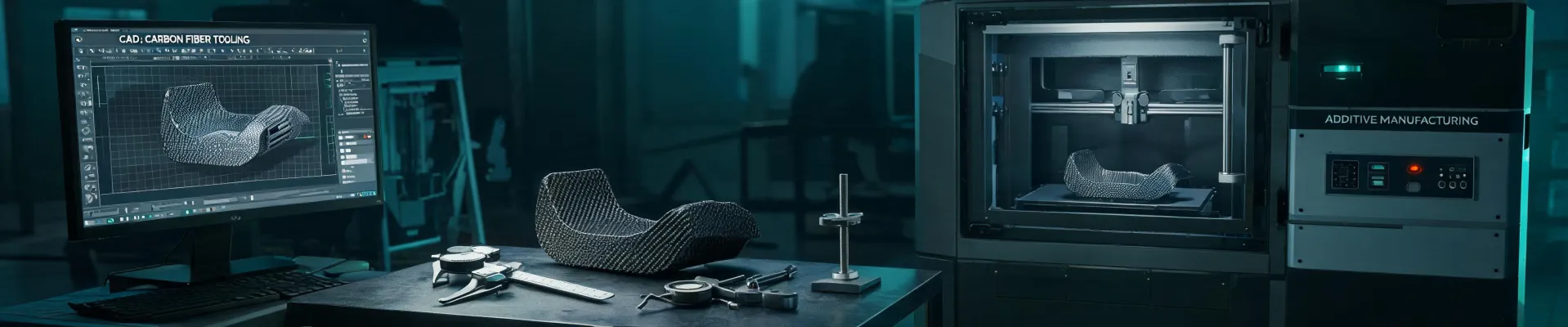
Here’s a point that often surprises people: carbon fiber 3D printing (the kind we specialize in at carbon-3d) can produce parts with strength-to-weight ratios that CNC machining from aluminum cannot match. Not in the same ballpark. A carbon fiber composite layup printed with continuous fiber has a tensile strength comparable to 6061 aluminum at a fraction of the weight. But—and this is the catch—the strength is anisotropic. It’s directional. The part is strongest along the fiber orientation, weaker across it. CNC machining from a billet gives you isotropic properties: the same strength in every direction. For a bracket that bears load in one axis, 3D-printed carbon fiber often wins. For a complex housing with loads from multiple angles, CNC-machined aluminum is usually the safer bet.
What I mean is: don’t compare “strength” as a single number. Compare “strength in your specific load direction.” Most buyers miss this and get stuck with a part that fails in an unexpected axis. That quality issue cost us a $22,000 redo and delayed our launch in Q1 2024 (ugh).
Dimension 2: Dimensional Accuracy and Tolerance
I ran a blind test with our manufacturing team last year: same bracket design—a simple L-shape with four holes—produced on a carbon fiber 3D printer and a 5-axis CNC mill. The CNC part held ±0.005 inches without breaking a sweat. The 3D-printed part? It came in at ±0.010 inches across the flat surfaces and ±0.015 inches on the holes. Not terrible (serviceable for many applications), but noticeably looser. Standard CNC machining generally holds ±0.005 inches or better. High-end 3D printing with carbon fiber reinforced materials can approach ±0.005 inches on the XY plane, but the Z-axis (layer direction) is always the weakest link. For press-fit assemblies or parts that mate with existing components, CNC machining is still the benchmark for repeatable accuracy. The exception: complex internal channels or lattice structures that CNC simply cannot cut. In those cases, you accept the tolerance looseness because the geometry is impossible otherwise.
(Not that tolerance specs are always honored. In our Q2 2024 audit, we rejected a batch of 50 CNC brackets because the hole positions were off by 0.008 inches—they’d skipped their in-process check. 5 minutes of verification beats 5 days of correction.)
Dimension 3: Surface Finish and Post-Processing
Surface finish is where the gap widens significantly. A CNC-machined aluminum part comes off the mill with a surface roughness (Ra) of 32 microinches or better. A carbon fiber 3D-printed part? You’re looking at 125–250 microinches straight off the printer, depending on layer height and fiber content. That’s a visible difference—rough, sometimes with fiber protrusions. Most buyers focus on per-unit pricing and completely miss post-processing costs. A 3D-printed carbon fiber part usually requires sanding and sealing before it’s ready for a customer-facing application. That adds time and labor. For an internal bracket that no one sees? The as-printed surface is often fine. For a consumer product component where feel and appearance matter? CNC machining (or an extensive finishing process on the printed part) is usually the answer.
Dimension 4: Total Cost of Ownership
Here’s where the simple “3D printing is cheap” assumption unravels. The cost per part for 3D printing is relatively flat: a few dollars in material plus machine time. For CNC machining, the cost drops sharply with volume because setup and programming are amortized. For a run of five prototype parts, 3D printing is almost always cheaper. For a run of 500 identical parts, CNC machining is dramatically cheaper per unit—often 60–70% less, depending on material and complexity. But there’s a hidden variable: revision cost. With 3D printing, you can upload a revised file and print again overnight. With CNC, a design change means reprogramming, re-fixturing, and potentially new tooling. The total cost of ownership includes not just the final production parts, but the cost of iterations to get the design right. For a design that’s still in flux, 3D printing’s low revision cost easily outweighs its higher per-unit cost.
(Between you and me, I’ve seen projects spend $8,000 in CNC reprogramming charges chasing a design that hadn’t been finalized. A 12-point checklist for design freeze would have saved them most of that.)
So, Which One Should You Choose?
I can’t give you a single answer—that would be irresponsible. But here’s a decision framework I use when auditing our own production:
- Choose carbon fiber 3D printing when: the part has complex internal geometry (lattices, conformal cooling channels), you need the highest strength-to-weight ratio in a single load direction, or you’re still iterating the design and need low revision cost.
- Choose CNC machining when: the part requires tight tolerances (±0.005 inches or better), isotropic strength, a smooth as-machined surface finish, or you’re producing more than 50–100 identical units.
The worst choice? Choosing either one without looking at your actual requirements. A lesson learned the hard way, multiple times.