
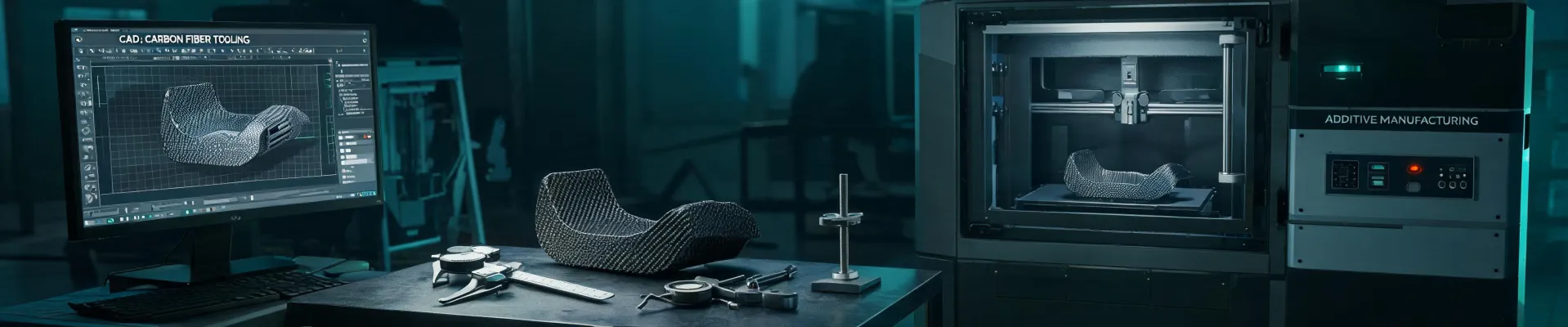
3D Printing Isn't a Magic Wand
Let me say this upfront: carbon fiber 3D printing is not a replacement for CNC machining, injection molding, or laser cutting. It's a complement. And if you think it can do everything, you're gonna waste money—I know because I have.
I've been handling custom manufacturing orders for 9 years now. I've personally made (and documented) about 30 significant mistakes, totaling roughly $4,000 in wasted budget on test parts, rushed materials, and redo fees. Now I maintain our team's checklist to prevent others from repeating my errors.
The reality is: people see "carbon fiber 3D printing" and assume it solves all their problems instantly. They think it's cheaper, faster, and stronger than everything else. But the truth is more nuanced—and knowing where it falls short is what makes it actually useful.
Why Most People Misunderstand Carbon Fiber 3D Printing
There's a misconception floating around that carbon fiber 3D printing is universally superior to traditional methods. People think the material itself makes parts indestructible and lightweight by default. But that's just not how it works.
Here's what I've learned the hard way: the strength of a carbon fiber 3D-printed part depends on orientation, infill pattern, and post-processing—not just the material. I've seen parts fail catastrophically because someone assumed the carbon fiber would compensate for poor design.
One example: In Q2 2022, we had a client who wanted a custom jig for their assembly line. They'd gotten quotes for both CNC and 3D printing. The 3D printing route was cheaper on paper. But when the part was printed, the layer adhesion was weak along the z-axis. The result? $890 in redo costs (ugh) plus a 1-week delay. In the end, they went with CNC anyway (which worked fine the first time).
So, the assumption is that cheaper upfront cost equals better value. The reality? The total cost includes redo risk, material waste, and lost time.
When Carbon Fiber 3D Printing Actually Shines
Okay, I'm not saying it's useless. Far from it. But I've found three specific use cases where it significantly outperforms alternatives:
- Low-volume parts with complex geometries: If you need 5–50 units of something with intricate internal channels or lattice structures, 3D printing is the winner. CNC would require expensive tooling changes, and injection molding is only cost-effective at scale.
- Applications that need high strength-to-weight ratio: The carbon fiber reinforcement can reduce weight by 20–40% compared to aluminum parts, which matters in aerospace or automotive prototyping.
- Rapid iteration scenarios: When you're still designing and need multiple versions in a week, 3D printing gives you flexibility. But this assumes you've got the right material profile dialed in.
But here's the catch: if you need flawless surface finish or tight tolerances (±0.1mm or better), you're better off with CNC or laser cutting. 3D printed carbon fiber parts often have visible layer lines and need post-processing (sanding, coating) to look smooth. I've had clients reject parts because the surface didn't match their expectations—even when the mechanical properties were fine.
The Hidden Costs Nobody Talks About
People focus on the per-unit price of a 3D-printed part. But there are costs you'll only discover after you've committed:
- File preparation fees: Some services charge $50–$150 for analyzing and optimizing your STL or STEP file. We once paid $120 for a complex assembly that took two rounds of revision.
- Failed prints: Even with the best settings, failures happen. On a batch of 20 parts, we lost 3 to warping due to inconsistent bed heating. That's 15% scrap rate right there.
- Post-processing costs: Removing support material, sanding, and coating adds $30–$60 per part depending on complexity. Clients often forget this because they see the smooth demo parts, not the as-printed reality.
And then there's the communication gap. I once told a vendor: "We need these parts in standard factory tolerance." They heard: "We can relax the specs." Result? Parts that didn't fit our assembly jig. We'd both said "standard" but meant different tolerances. Discovered this when the order arrived and nothing lined up.
What You Should Actually Use Carbon Fiber 3D Printing For
Based on my experience, here's my honest recommendation matrix:
Use carbon fiber 3D printing for: Low-volume, high-complexity parts where weight matters and surface finish isn't critical. Think brackets, housings, or prototyping custom fixtures.
Avoid it for: Parts that need mirror-like surfaces, high-temperature resistance (above 200°C), or mass production (>1,000 units). Consider CNC or injection molding for those cases (find relevant resources here).
One example: We recently made a custom cover for a medical device housing. 3D printing was the right call because we only needed 12 units, the part had complex internal routing for cables, and carbon fiber gave enough stiffness. But we spent an extra $400 on post-processing to achieve the required surface finish (which we'd planned for, thankfully).
Addressing the Obvious Objection
But isn't 3D printing always cheaper? That's what people ask me. And my answer is: only if you ignore hidden costs and tolerate imperfection.
The reality is that for high-volume or high-precision jobs, CNC machining or injection molding typically wins on cost per part and quality consistency. I've seen vendors charge $12/part for CNC (1,000 units) versus $30/part for 3D printing (same volume)—and the CNC parts had no layer lines.
The question isn't "which process is best?" It's "which process is best for this specific need?" And if your answer doesn't include honest evaluation of limits, you'll end up with a stack of failed parts and a lighter wallet.
3D printing is a toolbox tool, not a magic wand. Respect its strengths, acknowledge its weaknesses, and you'll get better results—and save money in the process.