
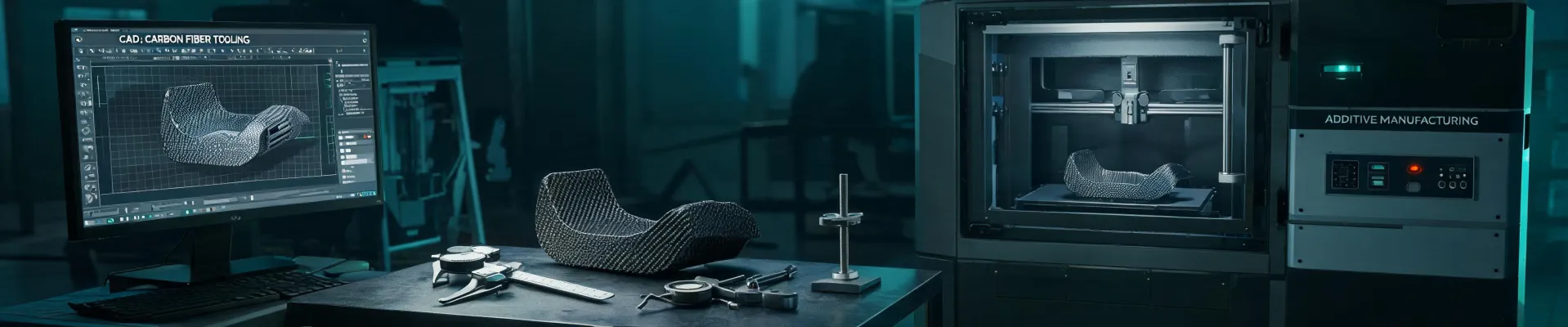
Tuesday, 7:40 AM. I was on my second coffee, checking photos from a customer's first production run, when I saw it: a build plate covered in a tangled nest of extruded plastic. In the trade, we call it spaghetti. Not the kind you eat.
I'm a quality and brand compliance manager at carbon-3d, an advanced manufacturing company. I review every part before it reaches customers—roughly 200 unique items each year. In Q1 2024, I rejected 8% of first deliveries because of tolerance drift, surface finish, or documentation issues. So when someone asks what causes spaghetti in 3d printing, I don't give a one-line answer. It's almost never one cause.
The customer in that photo was a small robotics startup. They had ordered a trial batch of parts in 3d printer carbon fibre filament. The order was small—I want to say around $400, but don't quote me on that. Small enough that a lot of shops would've ignored the email or set a $1,000 minimum. I'm glad we didn't.
They had been running the material on a desktop printer at home. Their first few parts looked okay. Then one night, the machine printed a nest. The part was ruined, the nozzle was probably damaged, and they had no idea what went wrong.
What causes spaghetti in 3d printing?
My first instinct was wet filament. Carbon fiber nylon is hygroscopic—it absorbs water from the air, and wet filament will bubble, hiss, and curl exactly like that. The data said something else. When we pulled the print logs, the machine was running a standard PLA profile at 210°C. That's too cold for most carbon fiber blends. The layers weren't fusing, the nozzle was catching, and after a few hours the model peeled off the bed.
There was also a bed adhesion problem. The build plate had fingerprints and dust all over it. First layer didn't stick, so the extruded plastic had nowhere to go but up into a tangle. A cold draft from an open window didn't help.
The surprise wasn't that the printer failed. Desktop printers fail. The surprise was that the root cause was boring. Wrong profile, dirty plate, a draft. Any one of those could've been fixed in ten minutes. But together, they made spaghetti.
If you search for '3d printer carbon fibre filament,' you'll find a lot of options. Some are excellent. Some are basically PLA with a little chopped carbon dust. The material name alone doesn't tell you what profile to use.
Carbon resin 3d printer vs carbon fiber filament
One quick clarification. A carbon resin 3d printer uses photopolymer resin with carbon particles, not filament. It doesn't produce spaghetti the way an FDM machine does. The failure modes are different: trapped air, incomplete curing, parts stuck to the film. But the rule is the same. Control the process before you blame the machine. We use resin printing at carbon-3d for certain prototype jobs, but for structural carbon fiber parts, we usually steer people toward filament or CNC machining.
The same pattern at a robot laser welding equipment factory
Later that year, I was part of a team qualifying a robot laser welding equipment factory for a client. The factory looked great on paper: modern robots, clean line, certifications. The first sample batch, though, had porosity in the welds. It wasn't visible until we cut sections and looked under magnification. The factory's engineers were confused. I wasn't.
Porosity in welding is a lot like spaghetti in 3D printing. The visible flaw is on the surface, but the cause is buried in preparation, shielding gas flow, travel speed, or material cleanliness. If you only fix the symptom, the next batch will fail the same way.
The rejected batch led to a $22,000 redo and delayed the launch. In quality, the cost of catching a defect early is almost always lower than the cost of shipping it.
Why we don't ignore small orders
This is where the small order angle comes in. The startup's first order with us was tiny. But the vendors who treated my $200 orders seriously when I was starting out are the ones I still use for $20,000 orders.
Small doesn't mean unimportant—it means potential.
We reprinted their parts on a more industrial machine, adjusted a few tolerances in their CAD model, and sent them a settings guide for their desktop printer. They've now ordered more parts, and they refer us to other startups. That's how B2B relationships should work.
I understand why some shops set minimums—the margin on a $200 order isn't always there. In my opinion, it's still worth looking beyond the first order. A small order is a test—for the customer and for the supplier. If both sides pass, the next order isn't small.
Specifications are a promise
In quality work, a spec is a promise. A part that should be 1.20 mm thick and comes in at 1.35 mm fails, even if it looks fine. Color is the same. We use Pantone standards for brand-critical colors: Delta E under 2 is the usual target, and above 4 is visible to most people, per Pantone Color Matching System guidelines. For inspection photos, we ask for at least 300 DPI because low resolution hides the defects we're looking for.
When I say a failed print isn't random, I do not mean every failure has one dramatic cause. I mean there's a chain of small process gaps. Find the chain, and you fix the problem for good.
One last odd connection. If you landed here after searching for 'vmc canelo drink calories,' you're probably in the wrong place. But trust me, the phrase is useful. A nutrition label is a specification. The consumer assumes the stated calories match the actual drink. If the label says 100 and the real number is 130, the product fails spec. Trust drops. Same with a printed part.
The real lesson
So, what causes spaghetti in 3d printing? Usually it's not the printer. It's the process around it:
- Wrong temperature profile for the material
- Poor bed adhesion—dirty plate, wrong z-offset, weak first layer
- Wet filament, especially carbon fiber composites
- Drafts or unstable room temperature
- Retraction or speed settings that cause under-extrusion and jams
If you're troubleshooting a failed print, start with the profile, then the plate, then the environment. And if you're choosing a manufacturing partner, don't discount small orders or small customers. Treat the first batch like it matters, because it does.