
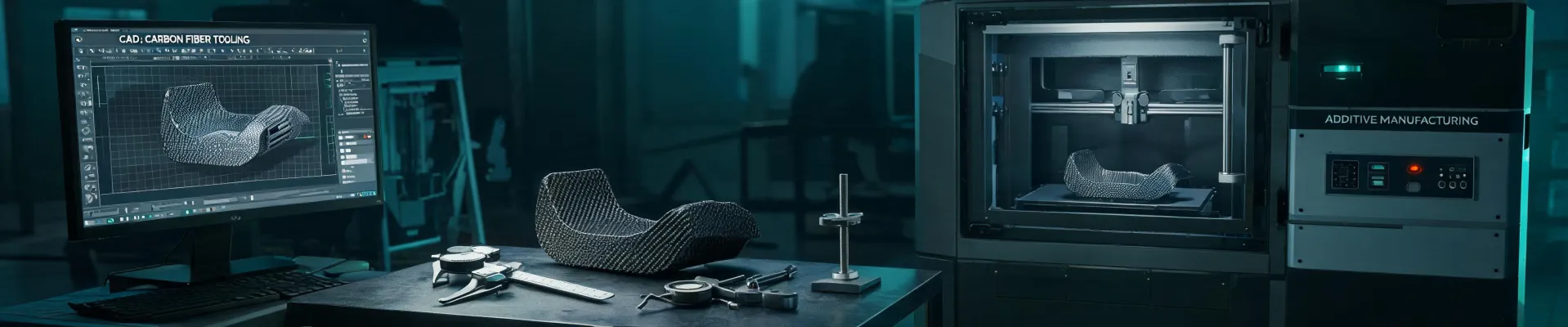
For small custom parts—think under 6 inches—carbon fiber 3D printing is usually the smarter call when geometry is complex. But if you need tight tolerances or functional prototypes fast, CNC machining wins every time. Here’s what 5 years and about $200k in annual procurement have taught me.
Look, I run ordering for a 50-person manufacturing company. I manage about 60–80 orders a year across 8 vendors. I’ve watched engineers argue for CNC, then switch to 3D printing, then argue back. The truth is: neither is universally better. The best choice depends on what you actually need. And I’ve paid the price for getting it wrong.
The Surface Illusion
From the outside, 3D printing looks like the future of manufacturing. It’s additive. It’s flexible. It promises complex shapes without tooling. What I didn’t see at first: the per-part cost can skyrocket for simple geometries, and material options are still limited compared to CNC.
People assume CNC is slower and more expensive. The reality is: once programmed, CNC can produce thousands of identical parts with tolerances of +/- 0.005 inches—which is why aerospace and automotive still rely on it. But for one-off prototypes or lattice structures? 3D printing wins hands down.
How I Learned This (The Hard Way)
Back in 2022, we needed 30 brackets for a new machine assembly. The engineer wanted carbon fiber 3D printing because it looked cool and was lightweight. I ordered from a specialty 3D printing service. The parts were beautiful—strong, porous-free carbon fiber. But they cost $85 each, and the surface finish required post-processing for our application. Total bill: $2,550 plus $120 shipping.
Later that year, same bracket design—but this time we needed 200 units for production. I switched to CNC. Setup fee was $450, but each part cost $22. Total for 200: $4,850. That’s less than double the 30-part 3D printing order. Net lesson: 3D printing is great for small batches (under 50), but CNC scales economically.
Then there was the time I went with the cheapest 3D printing quote I could find. Saved $150 on a $600 order. The parts came back with delamination on two edges. Reprinting cost another $450. That’s $600 spent on $450 worth of parts. The vendor who showed me the higher quote—with clear material specs and surface finish guarantees—would have saved me time and money. Transparency matters more than unit price.
When 3D Printing Beats CNC
- Complex geometry – Lattice structures, organic shapes, internal channels. CNC can’t easily do these. 3D printing can.
- Small quantities (1–10) – No tooling costs. No programming overhead. Just upload and print.
- Carbon fiber – Continuous-fiber 3D printing (like my experience with carbon-3d’s process) delivers strength-to-weight ratios that CNC can’t match without expensive layups.
- Weight reduction – Topology-optimized parts. Hollow forms. CNC requires machining from solid; 3D printing builds near-net-shape.
When CNC Machining Is Better
- High precision – Tolerances below +/- 0.005 inches. 3D printed parts are typically +/- 0.010 inches at best.
- Production runs (100+) – Once programmed, CNC mills run 24/7 with little labor. The cost per part drops fast.
- Surface finish – As-machined aluminum or steel looks professional. 3D printed parts often need sanding, vapor smoothing, or coating.
- Material variety – 6061 aluminum, 316 stainless, brass, plastics. 3D printing is catching up but still limited in engineering-grade metals.
The Metric That Matters: Total Cost of Delivery
Here’s the frame I use now: total cost of delivery = (unit price × quantity) + setup + shipping + rework + waiting cost.
Example from a real project: A heat sink prototype. 3D printing quoted $320 for 2 pieces, delivered in 5 days. CNC quoted $500 with $150 setup, 10 days. On paper, 3D printing was cheaper. But the engineer needed the part within 7 days to test the system. CNC would have missed the deadline. In that scenario, the “waiting cost” (delayed project timeline) was worth $8,000. So 3D printing saved us $8,000, not just $180.
On the flip side: for production, CNC’s lower per-unit cost beats 3D printing beyond a certain quantity. The crossover point varies by geometry and material, but for most small parts I’ve seen, it’s around 50–100 units.
A Few Caveats
I’m not saying 3D printing is always right or CNC is always wrong. There are exceptions:
- If you need waterproof or pressure-tight parts, CNC is safer. 3D printed parts can have micro-porosity unless post-processed.
- If you’re making parts for FDA or aerospace certification, CNC’s traceability and material consistency are advantages.
- If your volume is 500+ and the geometry is simple, injection molding might beat both. That’s a different conversation.
For most custom small parts, I start with geometry complexity and quantity. Complex shape + <50 units → 3D printing. Simple shape + >50 units → CNC. That rule of thumb has saved me about $12,000 in the last two years versus guessing.
Bottom Line
Honestly, the biggest lesson I’ve learned is to ask the right questions upfront. Not “which process is better?” but “what’s the total cost of getting this part in my hand, at quality, on time?” The vendor who answers that honestly—with itemized costs, not just a lump sum—is the one I trust. And trust saves more money than any discount ever could. (As of January 2025, at least.)