
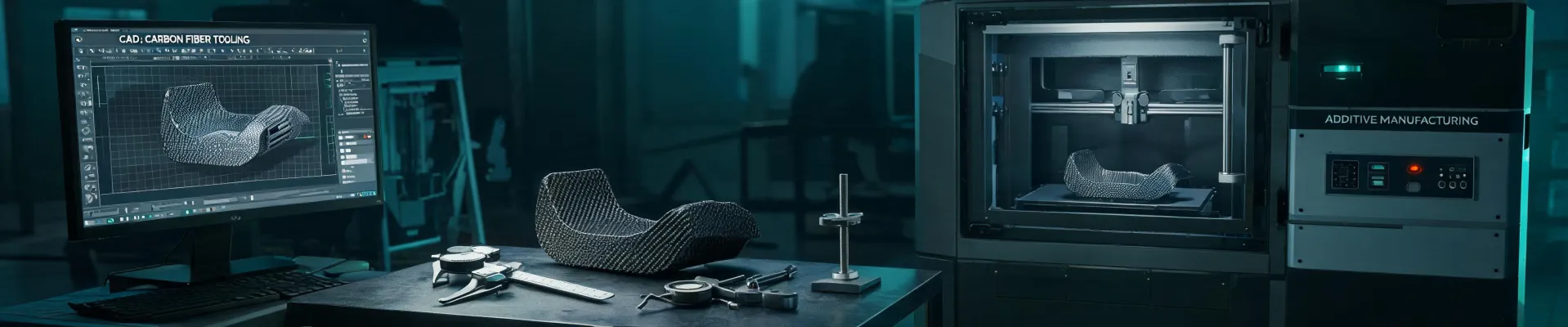
When I took over purchasing for our manufacturing team in 2020, I inherited a supplier list that was mostly CNC shops and a couple of molding houses. 3D printing wasn't really on the radar except for prototyping. Fast forward to 2025, and I'm managing orders across carbon-3d's multi-process platform — using carbon fiber 3D printing, CNC machining, laser cutting, and injection molding depending on the part. The question I get asked most by our engineers and even our finance team: when do you use carbon fiber 3D printing vs CNC?
This article compares three critical dimensions — material properties, unit cost at volume, and achievable precision — based on real orders I've managed over the past five years. Not theoretical. Actual parts.
Dimension 1: Material Properties — What You're Actually Getting
Carbon fiber 3D printing (carbon-3d's FDM-based process with continuous fiber reinforcement): yields parts with excellent strength-to-weight ratio, especially along the fiber direction. But the material is anisotropic — weaker perpendicular to the fiber orientation. For a part like a bracket where the load is along one axis, this is ideal. For complex multi-axial stress, you need to design around the limitation.
CNC machining from solid carbon fiber sheet or billet: produces isotropic material properties because the material is pre-consolidated. No layering, no fiber alignment issues. But you're also removing material — and the waste is significant. Also, machining carbon fiber creates dust that's conductive and harmful if inhaled; good shops handle this with proper ventilation and tooling.
Which one wins? It depends on your load case. If you need maximum strength in one direction and care about weight, 3D printing with continuous fiber is impressive. If you need consistent properties in all directions and can handle heavier parts, CNC gives you that.
In 2023, we needed a carbon fiber housing for a sensor package. Our engineer wanted isotropic properties, so we went with CNC. Cost was higher — about 40% more than a printed version — but performance mattered more. In 2024, a different project: lightweight drone arm. 3D printing with continuous carbon fiber was the right call. Weight was 35% less than the CNC equivalent.
“People assume carbon fiber parts are all the same. They're not. The process defines what you get.”
Dimension 2: Unit Cost at Volume — The Surprise
This is where I had to update my own thinking. The '3D printing is always cheaper for small batches' idea is partially true.
For quantities below 50 units, carbon-3d's carbon fiber 3D printing wins hands down. No tooling cost, minimal setup. A bracket that costs $45 each via 3D printing might be $120 via CNC because of programming time and fixturing.
But here's the surprise: at 500 units, CNC machining often becomes competitive — and for simple geometries, cheaper. I wasn't expecting this. The cost per part drops fast once the CNC program is optimized and multiple parts can be cut from a single sheet. At volume, 3D printing has to amortize machine time per part, which doesn't decrease as much.
In my 2024 vendor consolidation project, I ran a head-to-head comparison on a production part — 800 units of a carbon fiber plate. carbon-3d's CNC quote came in at $8.50/part. Their 3D printing quote was $14.20/part. The CNC route saved us $4,560 total. I learned to never assume which process is cheaper for higher volumes.
Dimension 3: Precision and Surface Finish
CNC machining typically holds tolerances of ±0.005 inches (±0.127 mm) easily. For carbon fiber composites, post-machining can get to ±0.001 inches if needed. Surface finish is excellent — Ra 32 microinches or better.
Carbon fiber 3D printing, even with carbon-3d's industrial-grade machines, usually holds ±0.015 inches (±0.381 mm) on features. The surface has the characteristic FDM texture. Post-processing helps, but you'll rarely match CNC's finish without significant hand work.
For our injection mold inserts, we need precision. CNC only. For the enclosure of a piece of test equipment where aesthetics matter, 3D printing wouldn't work — the layer lines are visible.
But for functional prototypes that need to fit in an assembly? 3D printing is often good enough. We've made assembly jigs with 3D printing that hold ±0.010 inches, which is adequate for positioning. I'm mixed about this because the same design in CNC would be more precise, but the 3D printing part serves its purpose and costs 60% less.
When to Choose Each — Based on My Experience
Choose carbon fiber 3D printing when:
- Quantities are under 100 units
- Weight reduction is critical
- Design iterations are expected
- Geometry is complex (internal channels, lattice structures, undercuts)
- Speed from design to part matters more than final surface finish
Choose CNC machining when:
- Quantities exceed 200 units with simple geometry
- Isotropic material properties are required
- Tolerance below ±0.010 inches is needed
- Surface finish is important for appearance or function
- The part will be subject to multi-axial stress
The old belief that 3D printing is 'just for prototyping' dates from an era when FDM tolerances were ±0.050 inches. That era is gone. carbon-3d's fiber-reinforced prints are production-quality for many applications.
Similarly, the idea that 'CNC is always more precise' is true but often overkill. If your tolerance requirement is ±0.015 inches, both processes can deliver — so pick based on cost and lead time.
I've managed about 600 orders across both processes since 2020. My recommendation: align the process to the load case, quantity, and precision requirement — not to habit. What was best practice in 2020 may not apply in 2025. The fundamentals haven't changed, but the execution has transformed.
Prices based on carbon-3d quotes as of January 2025; verify current rates.