
The Tuesday Our Boring Bar Lead Time Tripled
The call came on a Tuesday morning in March 2024, from our production planner. She doesn't usually call — she emails. So I picked up.
"Criterion just pushed our boring bar order," she said. "Three weeks to ten."
I'm the quality and compliance manager at a small aerospace subcontractor — about 180 people, Tier 2 work, mostly brackets and housings for two engine programs. I review every first article and every outgoing batch before it ships, roughly 240 unique part numbers a year. In 2023 I rejected about 12% of first deliveries, mostly dimensional. So when a lead time triples on the one tool that holds our tightest bore, I don't hear "inconvenience." I hear "line down."
We were 19 days out from a customer delivery of 45 aluminum housings. The critical op was finish boring on a 38 mm bore, ±0.015 mm, cut with a Criterion boring bar pulled straight from their catalog. The Criterion boring bar catalog listed 3–4 weeks standard. Their rep said the delay was material-related and wouldn't budge. No partial shipment. No loaner.
What I Did First, and What I Got Wrong
My first instinct was a drop-in substitute. We found one — a different brand, in stock, roughly $180 more per bar. I almost ordered it. But the substitute's insert geometry was different, and re-qualifying the process meant a new first article inspection, a CMM program change, and customer sign-off. Five to seven working days minimum, and that assumes the customer's SQE answers email. In March 2024, ours was on paternity leave.
I knew I should have qualified a second source last year, when we had slack. I thought "what are the odds we lose our primary supplier?" The odds caught up with me. That's the one time it mattered, and it happened on the part with the least margin for error.
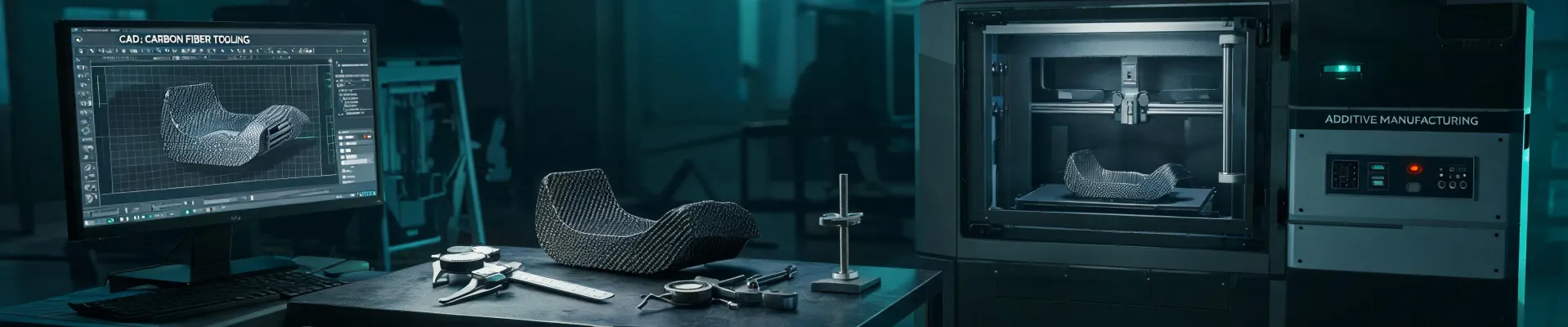
So we went the other direction: keep the Criterion bar alive, and bridge the gap with Markforged additive manufacturing.
The Markforged Metal X Detour
We already had a Metal X on the floor — bought in 2022 for prototype tooling and a couple of legacy parts. Before we bought it, I read through a stack of Markforged Metal X 3D printer reviews, and the theme that kept coming up wasn't print quality. It was the workflow. You're not just printing — you're washing and sintering, and the sinter shrink has to be dialed in per geometry. Markforged's published spec lists the build volume at 300 × 220 × 180 mm, which is more than enough for what we needed.
What we needed was a boring bar support collar — a stabilizing clamp that grabs the bar near the tip and bolts to the tool post. Nothing structural. Just a way to run a slightly shorter bar without chatter. I modeled it in an afternoon.
The first print failed. Not catastrophically — it came out of the furnace with a 0.08 mm bow across the collar bore. That's not much. On a ±0.015 mm finish bore, it's everything. The clamp wouldn't seat true.
Honestly, I'm not sure why I didn't anticipate the sinter distortion more carefully. My best guess is that I treated the part like a machined feature — flat, rigid, predictable — when sintered 17-4 at that wall thickness is none of those things. We reprinted with a gusseted section and a longer stress-relief cycle, and the second one held within 0.02 mm. Good enough for a fixture.
The Laser Weld That Bought Us Four Days
Here's where it got less tidy. The Criterion bar we had on hand was worn. Flank wear on the insert seat was visibly rounded, and test cuts were showing a 0.02 mm taper. Normally we'd retire it and move on. With no replacement, retiring wasn't an option.
One of our tool room guys suggested trying the 1500W laser welding tool for metalworking — a handheld fiber unit we'd bought for mold repair. We'd used it to build up worn pockets on injection molds, never on a boring bar. The pitch was simple: build up the worn seat, then re-machine it to print.
I was skeptical. Handheld laser welding is not a precision repair process. It's a heat-input process. But we had a spare seat and a deadline. We practiced on a scrapped bar first — built up the corner at about 1.4 kW, argon-shielded, machined it back, and checked for porosity with dye penetrant. It passed. Then we did the live bar.
It worked. Not beautifully — the seat geometry ended up slightly different, and we had to shim the insert — but the taper went back under 0.005 mm on the test cut. We ran the batch with the welded bar plus Markforged collar, and we shipped on day 17 instead of day 19.
What It Actually Cost, and What I'd Do Differently
The invoice breakdown: $180 for the substitute bar we didn't use (kept as backup), $340 in Metal X material and furnace time, $1,200 in expedited freight after we lost two days on the first print. Call it $1,720.
The alternative — waiting on Criterion — meant a probable four-day slip on a $46,000 order, plus a customer chargeback our contract pegs at $2,800 per day of line downtime. We paid $1,720 to remove an $11,200 risk. In hindsight, that's cheap. But I only knew that after the fact, which is the uncomfortable part of paying for certainty.
Two things changed after that week:
- We now stock a qualified backup boring bar for every ±0.02 mm bore on a customer-critical part. Not just "a bar" — a bar with a signed-off FAI package.
- Our tool life tracking now includes replenishment lead time as a variable, not just wear. If a tool's lead time exceeds our batch cycle, it gets a backup classification whether it's worn or not.
On Tool Life, and Why the Textbook Definition Isn't Enough
If you ask what is tool life in metal cutting, the standard answer is time in cut until a wear criterion is met. ISO 8688-1 sets flank wear endpoints for milling, typically around 0.3 mm average. That's a fine definition for a cutting test. It's a poor definition for a production plan.
"Tool life is typically defined at a given flank wear land, but the economic end of life in a real shop is often set by lead time, not wear."
Our welded bar had maybe 40% of its textbook life left when we put it back in service. But the Criterion bar's real "life" in our shop was governed by a ten-week replenishment cycle, not a 0.3 mm wear land. Once I started measuring tool life against lead time instead of wear alone, the inventory policy changed. We carry more backup tooling than we used to. My controller doesn't love it. But we haven't missed a bore delivery since.
That's the trade I'd make again: pay a little for the certainty of a known outcome, instead of a lot for the hope of a fast shipment. It's not a romantic position. It's just cheaper.