I'm a quality and compliance manager, not an applications engineer. That puts me in an unusual spot: I get pulled into discussions after a part already failed, when the actual mistake was choosing a process for the wrong reason. If you're comparing carbon 3D printing, CNC machining, and injection molding, stop looking for 'the best' process. There isn't one. There's a best process for a given part at a given point in its life.
Here is a 30-second primer for anyone who came here wondering how do 3D printers work. A 3D printer creates parts layer by layer with no hard tooling. CNC machining starts with a solid block and cuts material away. Injection molding injects molten material into a cavity and repeats that cycle quickly. Those basic differences drive most of the cost and quality tradeoffs you'll see.
At carbon-3d, we run industrial carbon fiber 3D printers, CNC machining centers, laser cutting and welding systems, and injection molding lines. That puts our sales team in an odd position. I don't have a favorite process. I have a least favorite process: whichever one was picked without thinking about total cost of ownership.
Scenario 1: Your design is still changing
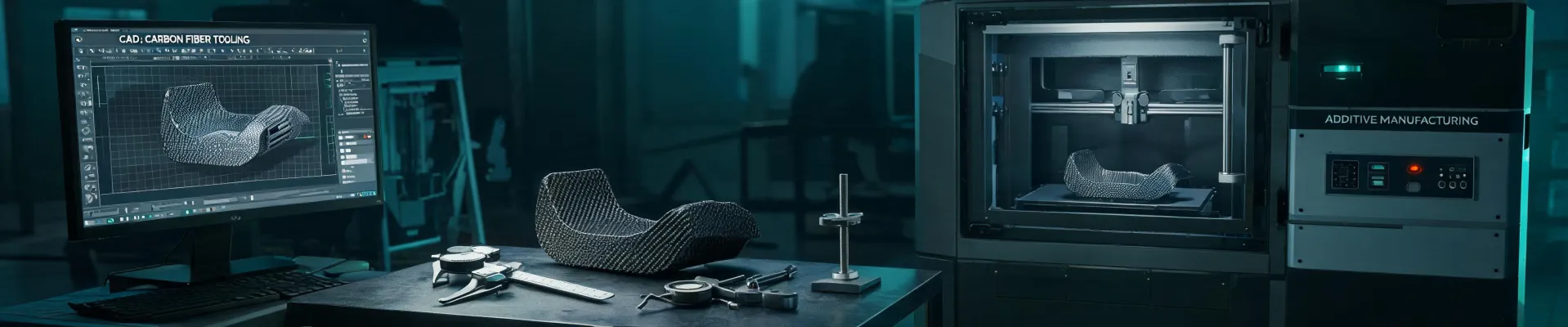
If your model has version numbers or open change requests, your first choice should usually be additive manufacturing. Industrial carbon 3D printers can create functional parts in carbon-nylon and other reinforced materials without hard tooling. A design revision costs little more than slicing time and material. It does not require fixture changes or expensive mold modifications.
You'll see many carbon 3D printers on the market, from desktop units to industrial production systems. I have mixed feelings about recommending 3D printing to every team. It isn't a magic solution. A layer-based part behaves differently from a machined part. Carbon fiber reinforcement adds stiffness, but you still need to design with layer orientation and support removal in mind. However, when speed of learning matters, additive manufacturing is hard to beat.
The common trap I see is buying a desktop carbon 3D printer to save money on service bureaus. A machine such as the Elegoo Centauri Carbon 3D printer is useful in some situations. It is not the same as an industrial production system. Teams count the purchase price, then get surprised by training time, material drying, failed builds, support removal, and maintenance. If an engineer spends many hours a week running the machine, the hidden cost can eat any savings.
My advice: use an outside service until your in-house printer would run near full time. If it won't, outsourcing is usually the lower total cost.
Scenario 2: Your design is frozen and you need repeatable parts
This is the scenario where I often contradict the standard advice. Many people assume 3D printing is always cheapest for low volumes. For simple geometries with tight tolerances, that assumption is wrong. A small machined bracket can be cut quickly from certified billet material. The same bracket on a 3D printer could take much longer, require supports, and show more part-to-part variation.
If your part is frozen and you need anywhere from 50 to 2,000 units, look seriously at CNC machining. I'm not saying every part should be machined. Complex topology and conformal features still favor additive manufacturing. But for flat surfaces, holes, threads, and predictable material properties, subtractive manufacturing often wins on consistency.
When you compare quotes, ask what is included in CNC machining supplies. Some shops list tooling, workholding, and inspection as adders; others bundle them into the unit price. There is no universal correct answer, but if you compare only quoted unit prices, you're missing half the calculation. The shop with the lowest unit price may be excluding first article inspection. That's a total cost issue, not just a quote issue.
In one Q1 2024 audit, every delayed project we reviewed had one thing in common: a vague specification. One client said 'standard finish,' and the machine shop interpreted that as 'no extra finishing.' The parts met dimensional tolerances but not the client's expectation. The fix was a written finish standard, not a different process.
Scenario 3: Your volume is high, steady, and the design will not change
If you have steady demand and a design that has survived validation, turnkey injection molding solutions should be part of the discussion. The tooling estimate will make you flinch. I get it. A hardened steel mold is expensive. But the total cost of ownership changes when you spread that tooling cost over a large number of parts.
Here is another reason to look at injection molding earlier than many engineers expect. A rapid aluminum tool can produce hundreds to a few thousand parts. That is not the million-piece world many older textbooks describe. If the design is stable and you intend to repeat the product in batches, a small mold can beat CNC even at moderate quantities.
Why use the word 'turnkey'? Because injection molding has more failure points than a one-step quote. It involves design for manufacturability, mold flow analysis, material selection, molding trials, dimensional inspection, and in many cases post-processing. When tooling and molding are done by separate vendors, the toolmaker points at the molder and the molder points at the material supplier. A turnkey contract puts one person in charge of the entire result.
For a quality manager, that single point of accountability is worth part of the premium.
How to figure out which scenario you are in
If you're not sure, ask yourself three questions.
- Is your design under formal change control? If yes, that's Scenario 1. If no, ask how confident you are that it won't change in the next 90 days.
- How many parts do you actually need in the first year? Use the forecast you can defend, not the optimistic one from the business case. The break-even between processes changes by an order of magnitude if those numbers are wrong.
- What happens if a part fails in service? If failure is expensive, pick the process with the most predictable material properties and the best inspection options, even if the unit price is higher.
Once you answer those, compare total cost, not quoted part price. Include engineering time, tooling amortization, inspection, field failures, shipping, and your schedule. A slightly higher unit part can look ordinary until you add the cost of a missed launch. That number is usually the biggest one on the spreadsheet.
My experience is mostly with industrial parts for medical, energy, and automotive clients. If you're working on a consumer hobby part, the thresholds may be different. The thinking process still applies.
At carbon-3d, we are happy to produce your part with 3D printing, CNC, laser processing, or injection molding. I would rather turn down a project than watch you choose a process based on unit price alone. That mistake cost me early in my career, and the lesson stuck.
So when a colleague asks me which process to use, my answer is still annoying: it depends. But now you know how it depends. Choose a scenario, run the total cost math, then get a quote. You will land in the right place far more often than if you started with a favorite technology.