
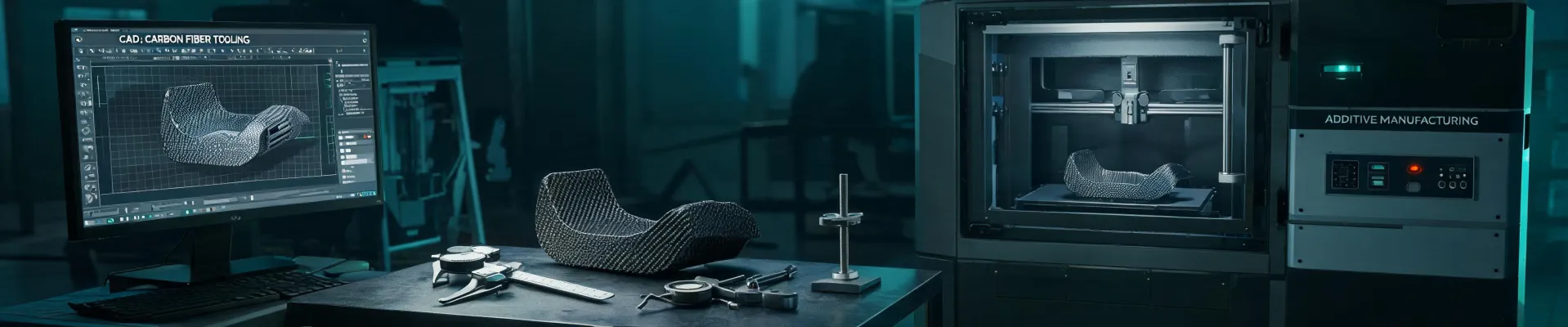
I'm the quality manager at carbon-3d, a custom manufacturing shop that handles carbon fiber 3D printing, CNC machining, laser cutting/welding, and injection molding. I review every order before it ships—roughly 1,200 unique parts a year. When a dimension is off or the finish doesn't match the approved sample, back it goes. That part of my job is simple.
The less simple part is the email that lands in my inbox a few times a quarter:
"We're launching a product. Should we buy Bambu Lab X1 Carbon 3D printer and run parts in-house, or should we use your service? And how much are filaments for 3d printers?"
I usually answer with a question: how stable is the design, and how many parts do you actually need? That tells me more than any spec sheet.
There isn't a universal answer, but it's not as fuzzy as people think. Most buy-versus-outsource questions fall into three scenarios. Once you identify which one you're in, the right move gets clear.
Scenario A: The design is still changing
If your geometry changes every couple of weeks—which is true for most prototypes—you're usually better off using a carbon fiber 3D printing service than running parts on your own machine. I admit that sentence sounds self-serving, so let me explain. It's not about equipment quality. It's about where your engineers spend their week.
During product development, the person editing the CAD file is the same person who would operate the printer. They'd be drying filament, watching the first layer, cleaning up failed builds, and logging new settings for every revision. Those are real hours that don't move the product forward. A service provider has already solved those process problems, so the part comes back ready for measurement, not for troubleshooting.
I didn't fully appreciate that until March 2023. A customer was designing a housing for a diagnostic instrument and asked whether he should print carbon fiber parts in-house instead of sending us iterations. We shipped the first revision in four days. By the time his printer quote was approved, his design had changed twice more. Every change would have meant recalibrating and starting over. He dropped the purchase and used a service until the design was locked.
The lesson is simple: five minutes of reviewing a drawing revision beats five days of correcting a part that was made from the wrong one. For moving designs, use the service.
Scenario B: The design is locked and volume is real
The calculation flips once a design stays stable for roughly ninety days and demand is repeatable. That's when owning equipment can start to win.
The trap in this scenario is comparing only the machine price and the material price. People ask: how much are filaments for 3d printers? When I checked retail listings in January 2025, carbon fiber nylon filament was around $60–70 per kilogram. Standard PLA was closer to $20–30 per kilogram. That sounds like an easy argument for in-house printing, until you count what actually happens on the floor.
Consider carbon fiber filament. It's abrasive. Nozzles wear out faster than they do with PLA. Filament absorbs moisture, so you need dry storage. Failed builds consume material that never lands in a finished part. And every first article needs an inspection before you release the batch. Cost per good part is the only number that matters.
Same logic applies outside 3D printing. If you're evaluating a PC-based CNC lathe machine, ask first: who will program it, who will maintain it, and who will inspect the first part? If you don't have an answer for at least two of those questions, the machine won't fix the gap—it'll just produce scrap faster.
Here's what surprises engineers: low volume almost always stays cheaper with a service. If you're making fewer than twenty or thirty identical parts per month, you're basically buying a machine and paying it to sit idle. The service spreads that idle time across many customers. Let them carry the overhead until your volume justifies the shift.
Scenario C: The part needs multiple processes
Some parts cross process boundaries: a 3D printed carbon composite housing with machined metal inserts, a laser cut gasket, a serial number marked on a curved surface. If you bring that in-house, you aren't buying one machine. You're building a small factory with a printer, a CNC, a laser, plus maintenance and calibration for each one.
This is where a multi-process manufacturer earns its keep. At carbon-3d, parts move between 3D printing, CNC, laser, and molding on the same work order. The benefit is not just one invoice. It's traceability. The exact revision number and inspection requirements follow the part internally, so nothing gets lost between outside vendors.
A special case: The equipment you already own
There's a fourth situation that doesn't involve buying at all.
A machine starts making inconsistent parts, and the default reaction is to look at replacements. Before you do, find out whether the current unit can be brought back to spec.
In 2024, one of our CO2 lasers failed a power test. Cutting quality had drifted over about two weeks. A service specialist explained that an ultrapulse co2 laser recovery, which means restoring the system's original pulse performance, could solve it. We paid for the recovery, ran a full test matrix on cut speed and edge quality, and the laser passed. It cost us less than one-fifth of a new resonator and took a few days.
If you don't have power logs or test cuts from before the failure, you're guessing. The same goes for a CNC axis that drifts: calibrate and measure before assuming the machine is at end of life. Prevention is almost always cheaper than replacement.
How to tell which scenario applies to you
Here's the checklist I walk through with customers who are on the fence:
- Is the design still changing? If yes, treat it as Scenario A and outsource until it stabilizes.
- Is demand below about 20–30 units per month? If yes, outsource unless you can keep utilization above 60%.
- Does the part require more than one process? If yes, use a multi-process service rather than building your own mini-factory.
- Can you name the person who will operate the equipment daily? If not, don't buy it.
- Do you have a documented first-article inspection step? If not, you have a process problem, not a purchasing problem.
- Do you have measurement data for the current process? If not, order a pilot batch from a service to get baseline numbers before committing capital.
Running through that list is the cheapest insurance you'll buy this quarter.
Bottom line: buy equipment when you can point to stable demand and the people to run it. Use a service when the design moves, volume is low, or the part spans several processes. And whichever route you pick, inspect the first result before you scale. The prevention mindset has saved me from more expensive rework than any machine purchase—so check early, not after the batch is done.