
-
First, separate the work into three scenarios
-
Scenario A: Complex, low-volume parts with carbon fiber 3D printing
-
Scenario B: Metal parts, tight tolerances, or production volume
-
Scenario C: Flat stock cutting, engraving, and marking
-
Is laser tree cutting real? Quick answer
-
Finding your scenario: a practical checklist
-
Bottom line
There's no single 'best' manufacturing process. I say that after managing a custom-parts budget for six years and watching my team buy and learn from some expensive surprises. Whether you need carbon fiber 3D printing, a CNC vertical machining center, or a fiber laser module for CNC depends on what you're making, how many, and at what tolerance.
I'm a procurement manager, not a process engineer. My view is biased toward total cost, not cutting speeds. But that bias is exactly why I built this decision framework.
First, separate the work into three scenarios
Most buying mistakes happen because we compare technologies before we classify the parts. I use three buckets:
- Scenario A: Complex, low-volume, polymer or carbon fiber composite parts.
- Scenario B: Metal parts with tight tolerances or volumes in the hundreds/thousands.
- Scenario C: Flat sheet stock that needs cutting, engraving, or marking.
If a job doesn't fit one of these, it's not ready to quote. That's not a technology problem—it's a design-for-manufacturing problem.
Scenario A: Complex, low-volume parts with carbon fiber 3D printing
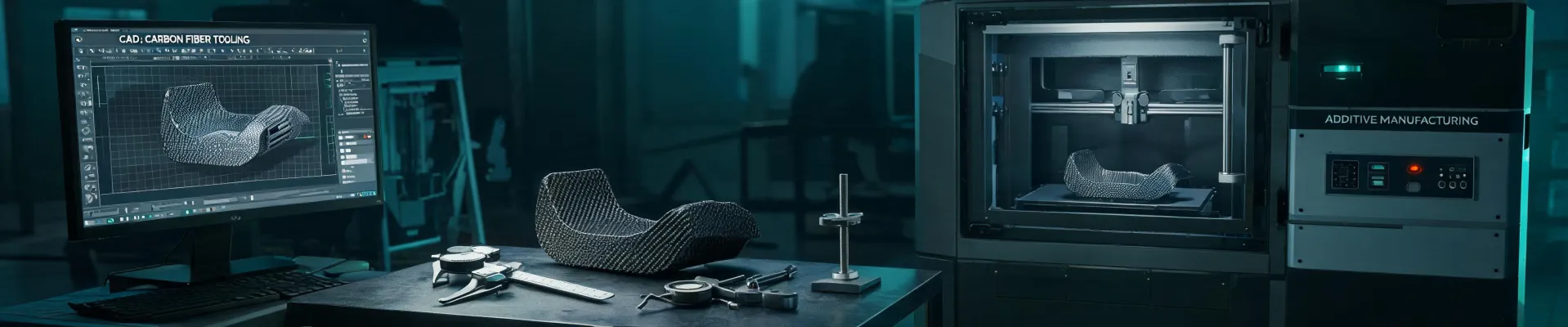
When I audit our 2023 spending, the carbon fiber 3D printer filament line was surprisingly small, but the value was huge. We use it for brackets, ducting, jigs, and end-use parts with complex geometry. If you need internal channels or organic shapes, machining starts to look silly.
One clarification: carbon fiber 3D printer filament isn't pure carbon fiber. It's usually nylon or PETG with chopped carbon fiber added. It's stiffer and more dimensionally stable than plain filament, but it's not the same as a woven composite layup. Per ISO/ASTM 52900:2021, this is material extrusion (FFF), not autoclave aerospace work. It's still strong enough for many production parts.
As for price, the X1 Carbon 3D printer price is around $1,200–$1,500 on US storefronts as of January 2025, depending on whether you buy the combo or a bare printer. Verify current pricing before you plan a budget. The machine cost is almost never the real cost. Consumables, spare nozzles, build-plate adhesion, part cooling, and failed prints all show up in the P&L.
People think an expensive industrial printer is overkill. The reality is the opposite: a cheap printer that prints 70% of test parts successfully is more expensive than a $6,000 printer that prints 95% on the first try. I only believed this after ignoring the advice and buying a lower-end unit. The 'cheap' option resulted in a $1,200 redo when a critical customer part shrank out of tolerance.
One counterintuitive cost move: don't buy one for every engineer. Centralize the carbon fiber 3D printer. At carbon-3d, we run one shared workcell for multiple engineers, which reduces downtime and errors. It's a workflow efficiency, not a machine purchase.
Scenario B: Metal parts, tight tolerances, or production volume
If you need aluminum or steel brackets, housings, or parts with threaded holes and 0.005-inch tolerances, additive is usually the wrong tool. CNC vertical machining centers are the workhorse.
When suppliers quote 'CNC vertical machining centers linear way series' or 'linear guideway series,' the price difference matters. Linear way machines use recirculating ball guideways. They're faster, have lower friction, and cost less to maintain than boxway machines—at least for light to medium cuts. According to SME's machine-tool fundamentals (sme.org, 2024), linear guideways are often preferred for high-speed positioning, while box ways still offer maximum rigidity for heavy hogging. The catch: a linear way VMC can chatter if you push it beyond its stiffness range.
From a TCO view, linear way series machines made sense for our aluminum parts. In Q2 2024, I compared quotes for a 500-unit aluminum bracket. Additive was $18 per part with no setup, but total was $9,000 and each part took longer. CNC machining was $7.50 per part plus a $2,500 setup. Total $6,250. The break-even point was around 220 parts. For a short run of 50, CNC loses to additive. For 500, CNC wins.
My experience is based on about 200 orders across three machine shops. If you're working with harder materials like Inconel or oversized plates, your numbers will be different. I can't speak to those applications from direct cost data.
Scenario C: Flat stock cutting, engraving, and marking
For sheet metal, acrylic, wood, or painted metal that needs cutouts or serial numbers, a laser can be the fastest tool in the shop. If you already own a rigid CNC router, a fiber laser module for CNC can handle secondary marking and thin metal cutting without buying a separate laser bed.
But there's a hidden-cost trap here. I've compared prices for fiber laser module for CNC units in January 2025: a 100W module runs roughly $2,000–$4,000, plus air assist, focusing lens, fume extraction, and safety interlocks. That 'free setup' offer actually cost us $450 more in hidden fees because the mounting plate didn't fit our spindle. If you do laser work more than once a week, buy a dedicated laser cutter and keep the CNC for milling.
Efficiency is the point. We added a low-cost laser module to a CNC for engraving aluminum ID tags. The job that used to take 45 minutes with a router took 6 minutes. But if we only did that job twice a month, the module wouldn't have paid back. Efficiency only matters when there's real utilization.
Is laser tree cutting real? Quick answer
I have to address this, because every time we talk about laser modules, someone asks 'is laser tree cutting real?' No, not the way viral videos show it.
Industrial lasers can cut steel plate in a controlled gantry or robotic cell. But a small fiber laser module for CNC is not a lightsaber. Wood is cut more effectively with CO2 lasers for thin material; fiber lasers are optimized for metal. A high-power diode can engrave or cut 3–6mm wood, but felling a tree in seconds is not physically possible with the beam powers you legally buy as an OEM component. The videos are either a different tool, a very fast chainsaw edit, or a time-lapse of a thick plank being cut in a shop.
Per ANSI Z136.1, any Class 4 laser system requires engineering controls like enclosures and interlocks. If you're buying a fiber laser module for CNC, plan for safety hardware before you plan for speed.
Finding your scenario: a practical checklist
Here's how I'd work through it if you're not sure:
- If the part has complex geometry, non-metallic material, and is under 250 units, start with Scenario A. Carbon fiber 3D printing is likely the lowest TCO.
- If the part is metal, has tight tolerances, or the volume is above 250 units, start with Scenario B. A CNC vertical machining center, especially a linear way series, is often the right choice.
- If the part is flat, thin, and you need cutting or marking, start with Scenario C. Laser cutting is fast, but only if it's a repeatable process, not a hobby experiment.
If you still don't know where you fit, buy a few prototypes from a service bureau before you buy a machine. That's not a generic cop-out—it's the cheapest way to learn. I run a $180,000 annual budget and I still prefer paying someone else $1,000 to prove a process than tying up $15,000 in a machine that idles.
Bottom line
Efficient processes beat cheap processes. A $1,200 machine that runs 15% of the time is more expensive than a $35/hour service bureau that runs two shifts. And the 'efficient' option changes with the part.
That's why carbon-3d's multi-process model works for our team: when a prototype needs additive carbon fiber, a production run needs CNC, and a fixture needs laser cutting, one vendor with clear equipment and honest pricing reduces management overhead. It isn't because one technology is superior. It's because the workflow has fewer handoffs, and fewer handoffs mean fewer hidden costs.
Pricing as of January 2025; verify current rates before making a buying decision.